Penetration Testing vs Vulnerability Scanning: What Your Business Actually Needs (2025)
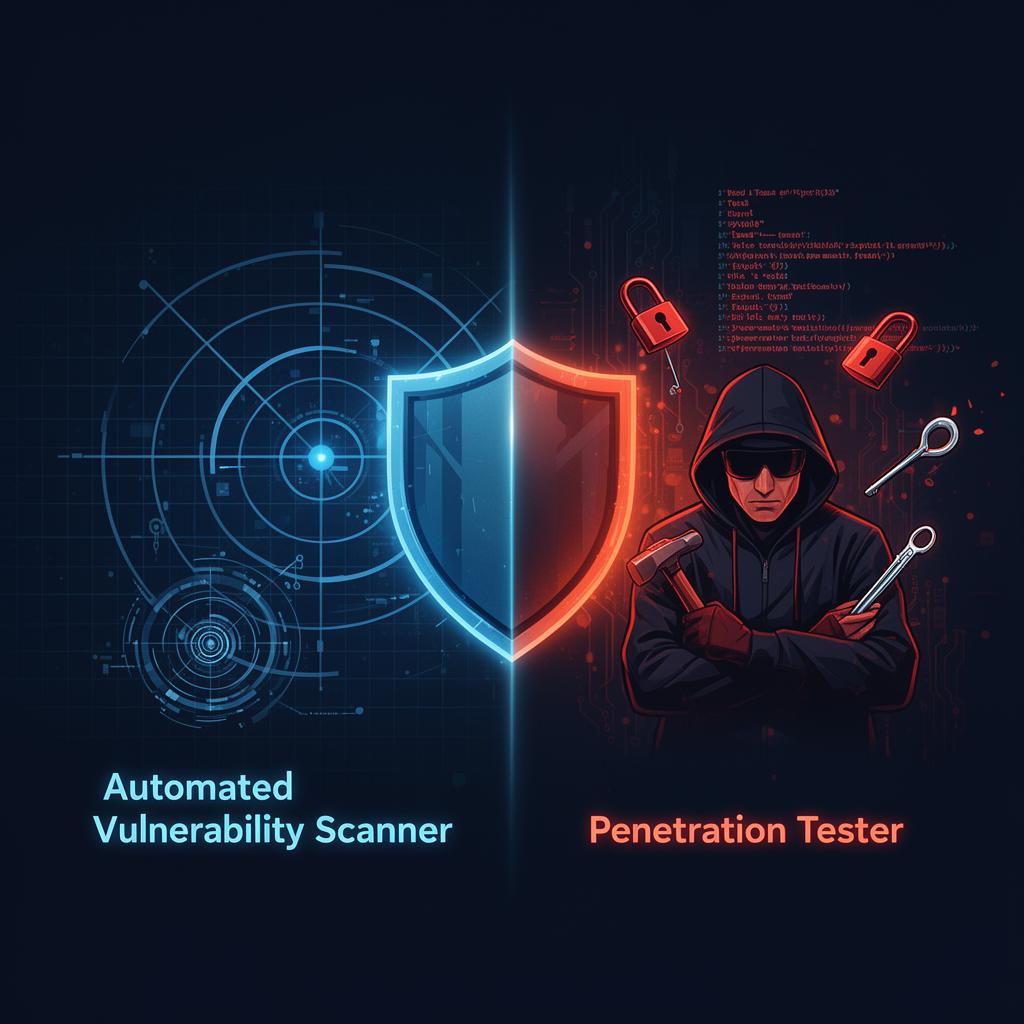
If you've ever asked your IT team whether your company has had a penetration test and they pointed to a vulnerability scan report, you're not alone — and you're not protected. The confusion between penetration testing and vulnerability scanning is one of the most expensive misunderstandings in cybersecurity, leading to false confidence, compliance gaps, and breaches that could have been prevented.
This guide breaks down the real differences, explains when each approach matters, and helps you build a security testing program that actually finds threats before attackers do.
The Core Difference: Automated Discovery vs. Human Exploitation
At the highest level, vulnerability scanning and penetration testing serve fundamentally different purposes — even though both fall under the umbrella of "security testing."
Vulnerability scanning is an automated process. Software tools crawl your network, applications, and infrastructure to identify known weaknesses — missing patches, misconfigurations, default credentials, and outdated software versions. Think of it as a building inspector checking that all the doors have locks.
Penetration testing is a human-driven exercise. Skilled security professionals actively attempt to exploit vulnerabilities, chain multiple weaknesses together, and simulate real-world attack scenarios. Continuing the analogy: a pen tester doesn't just check if the door has a lock — they try to pick it, find an open window, or social-engineer someone into handing over the key.
Vulnerability Scanning: The Foundation of Continuous Security
What It Does
- Scans networks, hosts, and applications against databases of known vulnerabilities (CVEs)
- Identifies missing patches, open ports, weak configurations, and protocol weaknesses
- Produces prioritized reports with severity ratings (Critical, High, Medium, Low)
- Runs automatically on schedules — weekly, daily, or even continuously
Key Strengths
- Breadth of coverage: Scans can assess thousands of assets in hours
- Cost-effective: Automated tools are significantly cheaper than manual testing
- Continuous monitoring: Scheduled scans catch new vulnerabilities as they're disclosed
- Compliance baseline: Satisfies PCI DSS Requirement 11.2, HIPAA technical safeguards, and similar standards
Limitations
- False positives: Scanners flag potential issues without confirming exploitability
- No business context: A "critical" CVE on a sandboxed dev server isn't the same as one on your payment processor
- Cannot chain vulnerabilities: Real attacks combine multiple low-severity issues — scanners test each in isolation
- Misses logic flaws: Business logic vulnerabilities, authentication bypasses, and privilege escalation paths are invisible to automated scans
Penetration Testing: Proving What's Actually Exploitable
What It Does
- Skilled testers simulate real-world attack scenarios against your environment
- Tests go beyond known CVEs to include social engineering, physical security, and custom exploitation
- Demonstrates actual business impact — "we accessed your customer database" vs. "port 443 is open"
- Provides narrative-style reports with attack paths, evidence, and remediation priorities
Types of Penetration Tests
| Type | Scope | Best For |
|---|---|---|
| External Network | Internet-facing systems, APIs, cloud services | Organizations with public-facing applications |
| Internal Network | Lateral movement, privilege escalation, Active Directory | Companies concerned about insider threats or compromised endpoints |
| Web Application | OWASP Top 10, business logic, authentication flows | SaaS companies, e-commerce, financial platforms |
| Wireless | Wi-Fi security, rogue access points, segmentation | Organizations with physical offices and guest networks |
| Social Engineering | Phishing, vishing, physical access attempts | Companies strengthening their human firewall |
| Red Team | Full-scope adversary simulation with minimal rules | Mature organizations testing detection and response capabilities |
Key Strengths
- Proves real risk: Demonstrates what an attacker can actually achieve, not theoretical vulnerabilities
- Finds chained attacks: Discovers attack paths that combine multiple low-severity issues into critical compromises
- Tests defenses: Evaluates whether your SOC, SIEM, and incident response procedures detect and respond to threats
- Satisfies advanced compliance: Required by PCI DSS 11.3, SOC 2 Type II, CMMC Level 2+, and many cyber insurance policies
Limitations
- Point-in-time: Results reflect security posture during the testing window only
- Higher cost: Manual testing by experienced professionals commands premium pricing
- Narrower scope: Time constraints mean testers focus on highest-value targets rather than every asset
- Requires skilled testers: Results vary dramatically based on tester expertise — certifications like OSCP, OSCE, and GPEN matter
Side-by-Side Comparison
| Factor | Vulnerability Scanning | Penetration Testing |
|---|---|---|
| Approach | Automated tools | Human-driven with tool assistance |
| Frequency | Weekly/monthly/continuous | Annually or after major changes |
| Depth | Broad but shallow | Narrow but deep |
| False Positives | Common | Rare — findings are validated |
| Business Impact | Lists potential risks | Demonstrates actual impact |
| Cost | $3,000–$15,000/year | $10,000–$100,000+ per engagement |
| Skill Required | IT operations can manage | Requires certified ethical hackers |
| Compliance Value | Baseline requirement | Advanced/premium requirement |
| Finds Logic Flaws | No | Yes |
| Tests Human Factor | No | Yes (social engineering) |
When You Need Vulnerability Scanning
Every organization needs vulnerability scanning — it's table stakes for basic security hygiene. Specifically, you need scanning when:
- You're building a security program from scratch — scanning establishes your vulnerability baseline
- Compliance requires it — PCI DSS, HIPAA, and NIST CSF all mandate regular vulnerability assessments
- You're deploying new infrastructure — scan before and after changes to catch misconfigurations
- You need continuous visibility — scheduled scans catch newly disclosed CVEs (like Log4Shell) across your environment
- You're managing patch cycles — scan results drive patching priorities and verify remediation
When You Need Penetration Testing
Penetration testing is essential when you need to validate that your defenses actually work against a determined adversary:
- Before a major launch — test new applications, platforms, or infrastructure before they're exposed to the internet
- After a significant change — mergers, cloud migrations, or architecture redesigns introduce risk that scanning can't fully assess
- For compliance certifications — SOC 2 Type II, PCI DSS Level 1, CMMC Level 2, and FedRAMP require pen testing
- When renewing cyber insurance — underwriters increasingly require annual pen test reports
- To test your SOC — red team exercises validate whether your managed security team detects and responds to real threats
- After a breach or incident — pen testing identifies whether the attack vector has been fully closed
The Real Answer: You Need Both
This isn't an either/or decision. Mature security programs layer both approaches:
- Continuous vulnerability scanning provides breadth — catching known issues across your entire attack surface, every week
- Annual penetration testing provides depth — proving what a skilled attacker can actually achieve against your most critical assets
- Quarterly or event-driven pen tests for high-risk environments — financial services, healthcare, defense contractors, and companies handling sensitive data
Think of it this way: vulnerability scanning is your smoke detector. It runs 24/7 and alerts you to known dangers. Penetration testing is your fire drill — it proves whether your team, tools, and processes actually work when the alarm goes off.
How to Scope a Penetration Test: 5 Questions to Ask
Not all penetration tests are created equal. Before engaging a firm, clarify:
- What's the objective? Compliance checkbox vs. genuine adversary simulation produce very different engagements
- What's in scope? Define networks, applications, cloud environments, and whether social engineering is included
- Black box, gray box, or white box? How much information does the tester start with? Black box (no info) simulates external attackers; white box (full access) maximizes finding depth
- What are the rules of engagement? Testing windows, off-limits systems, escalation procedures, and emergency contacts
- What certifications do the testers hold? Look for OSCP, OSCE, GPEN, GXPN, or CREST — not just CEH
Common Mistakes That Leave You Exposed
1. Using Scanning as a Substitute for Pen Testing
A vulnerability scan report is not a penetration test. If your compliance team or board sees a scan report labeled as a "pen test," you're exposed — both to attackers and to audit findings.
2. Annual-Only Testing
Testing once a year and ignoring security the other 364 days creates a false sense of security. Your environment changes constantly — so should your testing cadence.
3. Ignoring Remediation
A penetration test is only valuable if you fix what it finds. Establish SLAs: critical findings remediated within 48 hours, high within 2 weeks, medium within 30 days.
4. Choosing the Cheapest Provider
A $2,000 "penetration test" is almost certainly an automated scan with a different cover page. Quality pen testing requires experienced professionals spending days or weeks manually testing your environment.
5. Not Testing the Human Layer
Technical controls mean nothing if an employee clicks a phishing link and enters their credentials. Include social engineering in your testing program.
How BlueRadius Cyber Approaches Security Testing
At BlueRadius, we believe security testing should answer one question: "What can an attacker actually do to my business?"
Our penetration testing services are led by OSCP and GPEN-certified professionals who combine automated reconnaissance with manual exploitation techniques. We don't just run a scanner and hand you a PDF — we simulate the tactics, techniques, and procedures (TTPs) that real threat actors use against organizations like yours.
Our testing program integrates with our broader security offerings:
- Virtual CISO services translate pen test findings into board-ready risk reports and remediation roadmaps
- 24/7 managed security validates that our SOC detects simulated attacks during red team exercises
- Compliance programs ensure testing cadence and documentation satisfy SOC 2, PCI DSS, HIPAA, and CMMC requirements
- Security architecture reviews address the systemic issues that pen tests uncover
Building Your Security Testing Roadmap
Here's a practical framework for organizations at different maturity levels:
Stage 1: Foundation (0–6 months)
- Deploy automated vulnerability scanning across all assets
- Establish a patch management process driven by scan results
- Conduct a baseline external penetration test
Stage 2: Growth (6–18 months)
- Add internal network and web application pen testing
- Implement continuous scanning with integration into your ticketing system
- Begin phishing simulation campaigns
Stage 3: Maturity (18+ months)
- Conduct red team exercises testing detection and response
- Add wireless and physical security testing
- Integrate pen test findings into your security engineering pipeline
- Establish quarterly testing cadence for critical applications
Frequently Asked Questions
How often should we get a penetration test?
At minimum, annually and after any major infrastructure change. High-risk industries (healthcare, financial services, defense) should test quarterly. Compliance frameworks like PCI DSS require annual pen tests at minimum.
Can we do penetration testing in-house?
Internal security teams can conduct some testing, but independent third-party assessments are more credible for compliance and provide an unbiased perspective. Most compliance frameworks require external testing.
What's the difference between a pen test and a red team engagement?
Penetration tests have defined scope and seek to find as many vulnerabilities as possible. Red team engagements simulate real adversaries with specific objectives (e.g., "exfiltrate customer data") and test your organization's detection and response capabilities — not just your defenses.
Will penetration testing break our systems?
Professional pen testers use carefully controlled techniques and coordinate with your team. Rules of engagement define off-limits systems and testing windows. Disruptions are extremely rare with experienced providers.
How do we choose between vulnerability scanning tools?
Leading options include Qualys, Tenable Nessus, Rapid7 InsightVM, and OpenVAS (open source). The best choice depends on your environment size, cloud vs. on-prem mix, and integration requirements. Your virtual CISO can help evaluate options.
Take the Next Step
Whether you need a baseline vulnerability assessment or a full-scope red team engagement, BlueRadius Cyber delivers Fortune 500-grade security testing for mid-market companies. Our certified testers don't just find vulnerabilities — they prove business impact and help you fix what matters most.
Related from the BlueRadius Library
Sourced posts on adjacent topics, ranked by tag overlap.
Compliance
ISO 27001 vs SOC 2: Which Compliance Framework Does Your Company Need? (2026)
ISO 27001 vs SOC 2 compared: certification vs attestation, the shared control core, how to choose, and whether to pursue both. A 2026 mid-market guide.
ReadCompliance
PCI DSS 4.0.1 Compliance: A Mid-Market Guide for 2026
A PCI DSS 4.0.1 compliance guide for mid-market companies: merchant levels, SAQ selection, what changed in 4.0, and a step-by-step readiness checklist.
ReadCompliance
SEC Cybersecurity Disclosure Rules: What Mid-Market Companies Need to Know in 2026
How SEC cybersecurity disclosure rules affect mid-market companies. Four-day reporting, board oversight, and what to prepare now.
ReadCompliance
McLean FedRAMP Compliance Services: Authorization for Government Cloud
McLean VA companies seeking FedRAMP authorization: expert guidance from readiness assessment to P-ATO and ATO for government cloud services.
ReadCompliance
San Diego Defense Contractor CMMC Compliance: A Complete Guide
San Diego defense contractors: achieve CMMC Level 2 compliance with guidance on CUI protection, NIST 800-171 controls, and certification.
ReadCompliance
Cleveland Supply Chain Cybersecurity Compliance: Protecting Vendor Networks
Manage supply chain cyber risk for Cleveland businesses: vendor assessment, third-party risk management, and supply chain security in Ohio.
ReadRelated services