What is SOC 2 Compliance? The 2025 Executive Guide
If you’re a B2B technology company, chances are you’ve encountered the phrase “SOC 2 compliance” during sales conversations, customer security questionnaires, or contract negotiations. For many business leaders, SOC 2 starts as just another compliance acronym—but it quickly becomes a make-or-break requirement for landing enterprise clients.
This comprehensive guide explains everything executives need to know about SOC 2 compliance: what it is, who needs it, how to get certified, and what it costs. Whether you’re considering SOC 2 for the first time or trying to understand the difference between Type 1 and Type 2 reports, this guide will give you the clarity you need to make informed decisions.
What is SOC 2?
SOC 2 (System and Organization Controls 2) is an auditing framework developed by the American Institute of Certified Public Accountants (AICPA) that evaluates how service organizations manage and protect customer data.
Unlike compliance standards focused on specific industries (like HIPAA for healthcare), SOC 2 is designed for any service organization that stores, processes, or transmits customer data—particularly those offering cloud-based services, SaaS platforms, or managed technology services.
The Origins of SOC 2
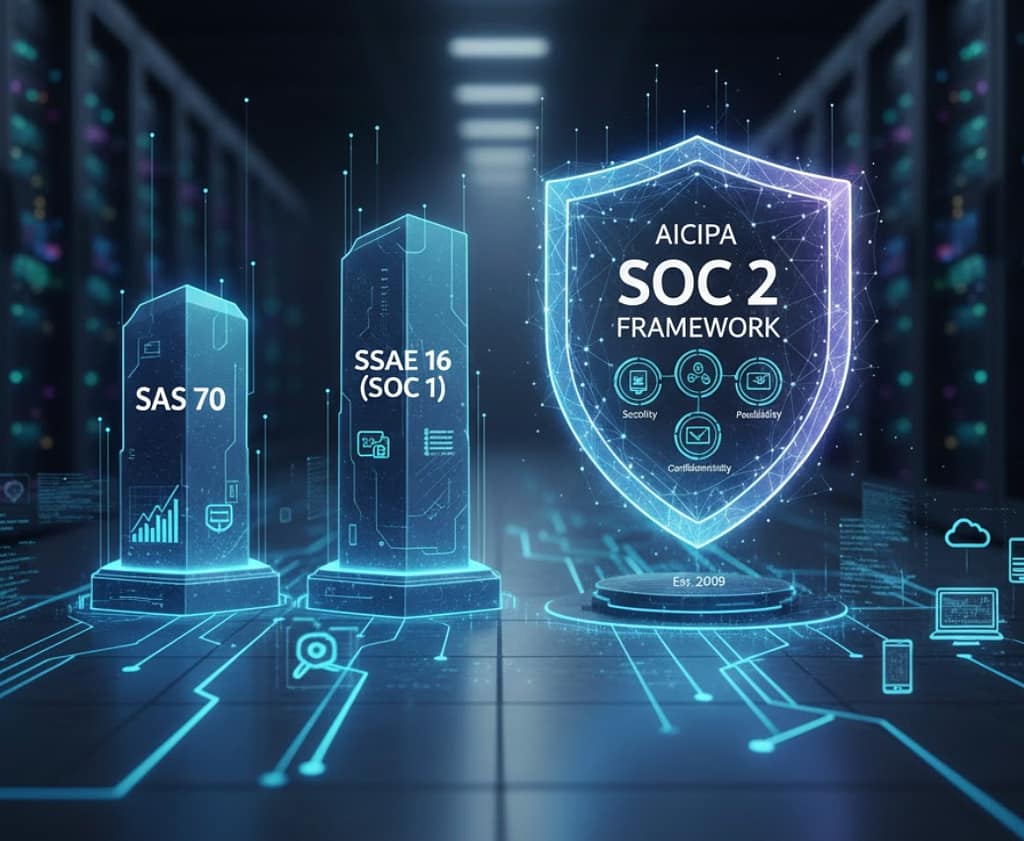
SOC 2 evolved from the Statement on Auditing Standards (SAS) 70, an audit that Certified Public Accountants (CPAs) used to assess organizations’ internal controls. The AICPA later replaced SAS 70 with Statement on Standards for Attestation Engagements (SSAE) 16, which became SOC 1. In 2009, AICPA introduced SOC 2 as an audit report with a strict security focus and issued the five Trust Services Principles.
Why SOC 2 Matters
SOC 2 compliance isn’t legally required, but it’s become a de facto standard for technology vendors and managed service providers working with regulated industries or storing sensitive data. In today’s environment where data breaches cost an average of $4.88 million globally, enterprise buyers demand proof that their vendors can protect sensitive information.
Bottom line: SOC 2 certification demonstrates to customers, partners, and stakeholders that your organization takes data security seriously and has implemented effective controls to protect their information.
Understanding the Five Trust Services Criteria
SOC 2 compliance relies on five Trust Services Criteria (TSC) that assess an organization’s security and data protection practices. These criteria form the foundation of what auditors evaluate during a SOC 2 audit.
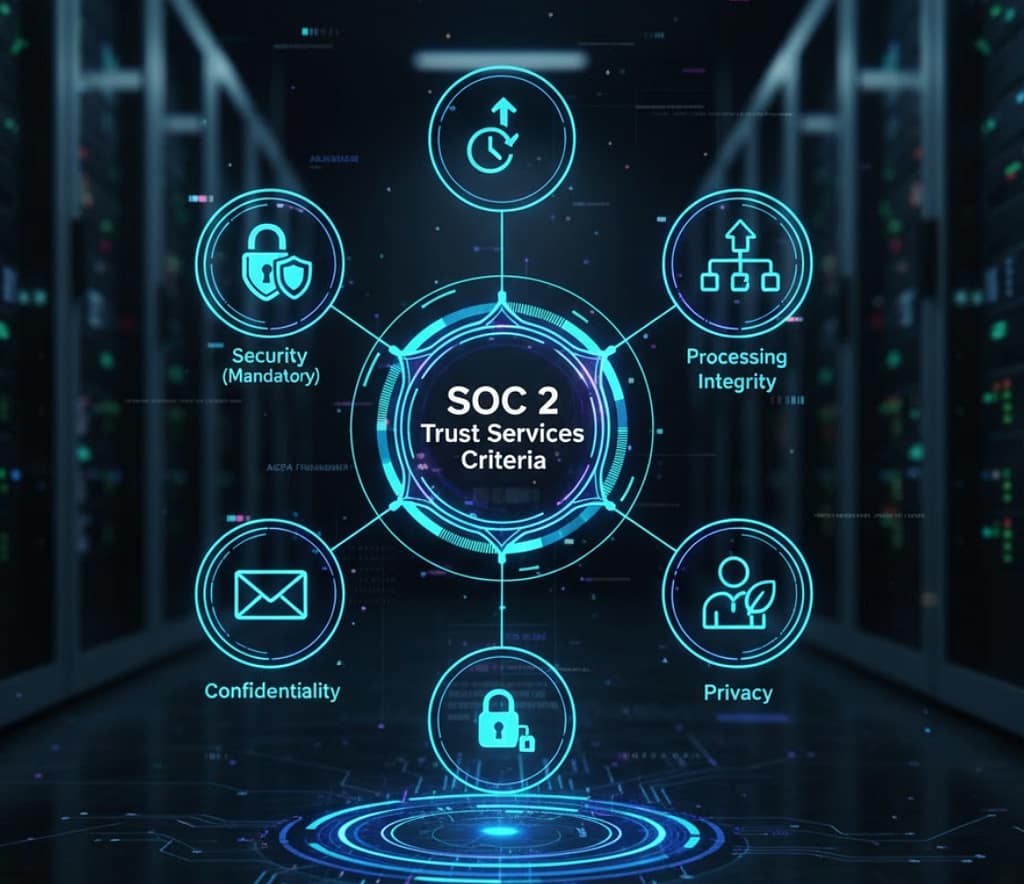
1. Security (Mandatory)
Security is the only criterion that is compulsory in every SOC 2 audit. This criterion addresses how your organization protects system resources from unauthorized access, including:
- Network security and firewalls
- Intrusion detection systems
- Access controls and authentication
- Vulnerability management
- Security incident response procedures
Organizations struggling to implement these security controls often benefit from comprehensive security risk assessments to identify gaps before beginning SOC 2 preparation.
2. Availability (Optional)
Availability ensures systems, products, or services remain accessible with minimal downtime, either as contracted or listed in service level agreements (SLAs). This criterion focuses on:
- System uptime and performance
- Disaster recovery capabilities
- Business continuity planning
- Infrastructure monitoring
- Backup and redundancy systems
3. Processing Integrity (Optional)
Processing integrity addresses whether a system achieves its purpose in a complete, valid, accurate, timely, and authorized manner. Key areas include:
- Data quality controls
- System processing accuracy
- Error detection and correction
- Transaction authorization
- Output completeness validation
4. Confidentiality (Optional)
Confidentiality protects information designated as confidential, covering:
- Encryption standards
- Data classification policies
- Access restrictions to sensitive data
- Secure data transmission
- Confidential information handling procedures
5. Privacy (Optional)
Privacy addresses the collection, use, retention, disclosure, and disposal of personally identifiable information (PII) and its alignment with the organization’s privacy notice and AICPA’s Generally Accepted Privacy Principles (GAPP). This includes:
- Privacy policy documentation
- Consent management
- Data subject rights (access, deletion, portability)
- Third-party data sharing controls
- PII disposal procedures
Important Note: While Security is mandatory, organizations choose which of the other four criteria to include based on their services and customer requirements.
SOC 2 Type 1 vs. Type 2: What’s the Difference?
One of the most common sources of confusion for business leaders is understanding the difference between SOC 2 Type 1 and Type 2 reports. Both follow the same Trust Services Criteria, but they differ significantly in scope and value.
SOC 2 Type 1 Reports
SOC 2 Type 1 is a point-in-time report that evaluates whether an organization’s controls are suitably designed to meet the applicable Trust Services Criteria at a single point in time.
What Type 1 Assesses:
- Design of security controls
- Policy documentation
- System descriptions
- Control framework structure
Type 1 Timeline: The timeline for achieving SOC 2 Type 1 certification is roughly one and a half to three and a half months.
Type 1 Cost: The cost typically ranges from $10,000 to $25,000, depending on the scope and complexity of your organization.
When to Choose Type 1:
- You need to demonstrate compliance urgently for a customer contract
- Your company is newly established with limited operational history
- You’ve recently implemented major security changes
- Budget constraints require a lower-cost option initially
- You want to identify gaps before pursuing Type 2 certification
SOC 2 Type 2 Reports
SOC 2 Type 2 covers operational effectiveness over a monitoring period of 6-12 months, proving that security controls are not just designed properly but also function reliably over time.
What Type 2 Assesses:
- Control design (like Type 1)
- Operational effectiveness over time
- Consistent implementation
- Evidence of continuous monitoring
Type 2 Timeline: The timeline for achieving SOC 2 Type 2 certification is roughly five and a half to 17 and a half months, consisting of a preparation phase, observation period, and the official audit.
Type 2 Cost: Costs range from $15,000 to $50,000+, largely influenced by the length of the observation period, auditor fees, and internal resource requirements.
When to Choose Type 2:
- Your security controls are well-established and have been operating for months
- Enterprise customers specifically request Type 2 certification
- You want to demonstrate long-term commitment to security
- Competitive differentiation requires stronger validation
Which Report Do You Need?
Many potential customers are increasingly rejecting Type 1 reports, preferring Type 2 certification that demonstrates consistent security practices over time. However, some clients may only require a snapshot of your control environment (Type 1), while others need the assurance of operational effectiveness over time (Type 2).
Many organizations find that working with a Virtual CISO helps them make this strategic decision based on customer requirements, competitive positioning, and resource availability.
Best practice: If time and budget allow, pursue SOC 2 Type 2 directly. Many organizations use Type 1 as a stepping stone, but this approach ultimately requires two separate audits and may not satisfy your most important customers.
Who Needs SOC 2 Compliance?
SOC 2 certification isn’t legally mandated, but it’s become essential for specific types of organizations and business scenarios.
Organizations That Typically Need SOC 2:
1. SaaS and Cloud Service Providers Companies offering software-as-a-service, platform-as-a-service (PaaS), or infrastructure-as-a-service (IaaS) solutions that handle customer data.
2. Technology Vendors Serving Enterprises B2B technology companies selling to Fortune 500 companies, regulated industries, or government entities.
3. Managed Service Providers (MSPs) Organizations providing IT management, security monitoring, or technical support services that access client systems. Learn more about how MSPs add SOC 2 services.
4. Data Processing Companies Businesses that handle, store, or process sensitive customer information on behalf of other organizations.
5. Healthcare Technology Companies Health tech startups and platforms handling protected health information (PHI), especially those needing both HIPAA and SOC 2 compliance. Healthcare organizations must often balance HIPAA compliance requirements with SOC 2 certification to satisfy both regulatory and commercial customers.
6. Financial Technology (FinTech) Companies Payment processors, banking platforms, investment tools, and other fintech solutions handling financial data. Dallas-area financial services firms can explore our specialized cybersecurity services for banks and credit unions.
7. Remote Work and Collaboration Tools Companies providing communication, project management, or file-sharing platforms used by distributed teams.
Signs You Need SOC 2:
- Enterprise prospects request SOC 2 reports during security reviews
- Your sales team reports losing deals due to lack of certification
- Customer security questionnaires specifically ask about SOC 2
- You’re expanding into regulated industries (finance, healthcare, government)
- Investors or board members identify SOC 2 as a business priority
- Competitive analysis shows your competitors have SOC 2 certification
For companies serving the Austin SaaS ecosystem, we’ve created a specialized guide on virtual CISO services for SOC 2 compliance.
The SOC 2 Compliance Process: Step-by-Step
Achieving SOC 2 certification involves several distinct phases, whether you’re pursuing Type 1 or Type 2 certification.
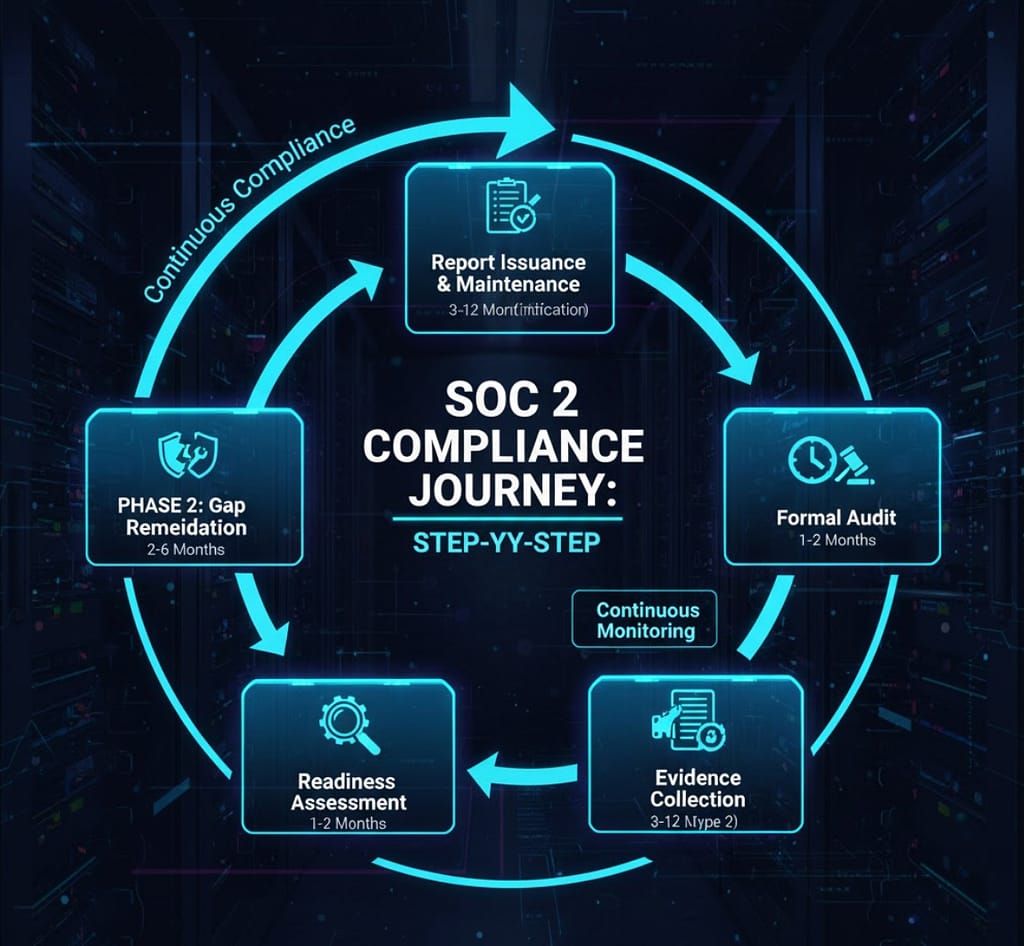
Phase 1: Readiness Assessment (1-2 Months)
Before engaging an auditor, conduct an internal readiness assessment to identify gaps:
- Evaluate existing security controls against Trust Services Criteria
- Document current policies and procedures
- Identify missing controls or documentation
- Determine which TSC criteria apply to your services
- Estimate remediation effort and timeline
Pro tip: Many organizations benefit from working with a virtual CISO during SOC 2 preparation to accelerate this phase and avoid common pitfalls.
Phase 2: Gap Remediation (2-6 Months)
Implement missing controls and address identified weaknesses:
- Develop or update security policies
- Implement technical controls (encryption, access management, monitoring)
- Establish vendor risk management program
- Create incident response procedures
- Deploy security awareness training
- Set up evidence collection processes
Implementation often requires penetration testing to validate technical controls and identify vulnerabilities before the formal audit.
Phase 3: Evidence Collection (For Type 2 Only: 3-12 Months)
Type 2 audits require ongoing evidence collection such as logs, reports, access reviews, incident records, and change management documentation to validate that controls are consistently enforced throughout the designated timeframe.
During this observation period, you must:
- Maintain continuous operation of all controls
- Collect and organize audit evidence
- Document any control changes or exceptions
- Track and remediate security incidents
- Conduct regular compliance reviews
Organizations often struggle with manual evidence collection, which is why GRC platforms require expert vCISO guidance to be truly effective.
Phase 4: Formal Audit (1-2 Months)
An unbiased third party—either a firm with AICPA certification or an individual CPA—must audit your business to receive a SOC 2 report.
The audit process includes:
- Opening meeting and scope confirmation
- System walkthrough and documentation review
- Control testing and evidence validation
- Employee interviews
- Technical environment assessment
- Audit findings discussion
- Report drafting and management review
Many companies conduct internal cybersecurity audit preparation reviews before engaging external auditors to identify issues early.
Phase 5: Report Issuance
Upon successful completion, you receive your SOC 2 report, which includes:
- Independent auditor’s opinion
- Management’s assertion
- System description
- Trust Services Criteria assessment
- Control testing results (for Type 2)
- Any exceptions or qualifications
You can then share this confidential report with customers, prospects, and stakeholders under non-disclosure agreement.
For detailed implementation guidance, see our 90-day SOC 2 implementation roadmap.
How Much Does SOC 2 Compliance Cost?
SOC 2 costs vary significantly based on organizational size, complexity, and chosen scope. Understanding these costs helps business leaders budget appropriately and make informed decisions.
Direct Audit Costs
Type 1 Audit Fees:
- Small organizations (< 50 employees): $10,000 – $15,000
- Mid-size organizations (50-500 employees): $15,000 – $25,000
- Large organizations (500+ employees): $25,000 – $50,000+
Type 2 Audit Fees:
- Small organizations: $15,000 – $25,000
- Mid-size organizations: $25,000 – $50,000
- Large organizations: $50,000 – $100,000+
Additional Costs to Consider
Compliance Automation Tools:
- GRC platforms (Vanta, Drata, SecureFrame): $12,000 – $60,000 annually
- Security monitoring tools: $5,000 – $50,000 annually
Organizations often wonder whether GRC automation platforms can replace expert guidance. Our research shows that GRC platforms fail without vCISO guidance because tools can’t interpret complex requirements or make strategic decisions.
Internal Resources:
- Project management: 100-400 hours
- Technical implementation: 200-800 hours
- Documentation and policy development: 100-300 hours
External Consulting (Optional):
- Readiness assessment: $5,000 – $20,000
- Gap remediation support: $10,000 – $50,000
- Virtual CISO services: $8,000 – $20,000 monthly
Technology Upgrades:
- Security tools and infrastructure improvements: $10,000 – $100,000+
- Varies significantly based on existing security posture
Ongoing Maintenance:
- Annual re-certification: 60-80% of initial audit cost
- Continuous monitoring and evidence collection: $20,000 – $60,000 annually
Total Cost of Ownership
First-Year Type 1 (Small Organization): $35,000 – $75,000 First-Year Type 2 (Small Organization): $50,000 – $125,000
Cost estimates based on 2025 industry data. Actual costs vary by organization size, complexity, and scope.
These estimates assume:
- Reasonable existing security posture
- Security criterion only (not all five TSC)
- Internal project management
- Some technology already in place
Cost Reduction Strategies
- Start with security criterion only – Expanding scope to all five TSC significantly increases costs
- Leverage existing tools – Maximize use of current security stack before purchasing new solutions
- Choose appropriate Type – Type 1 costs 30-50% less than Type 2
- Engage a vCISO – Virtual CISO guidance often reduces total costs by preventing expensive mistakes and accelerating timelines
- Select efficient observation period – For Type 2, a 3-month period costs less than 12 months
SOC 2 vs. Other Compliance Frameworks
Business leaders often face decisions about which compliance frameworks to pursue. Understanding how SOC 2 compares to alternatives helps prioritize your compliance roadmap.
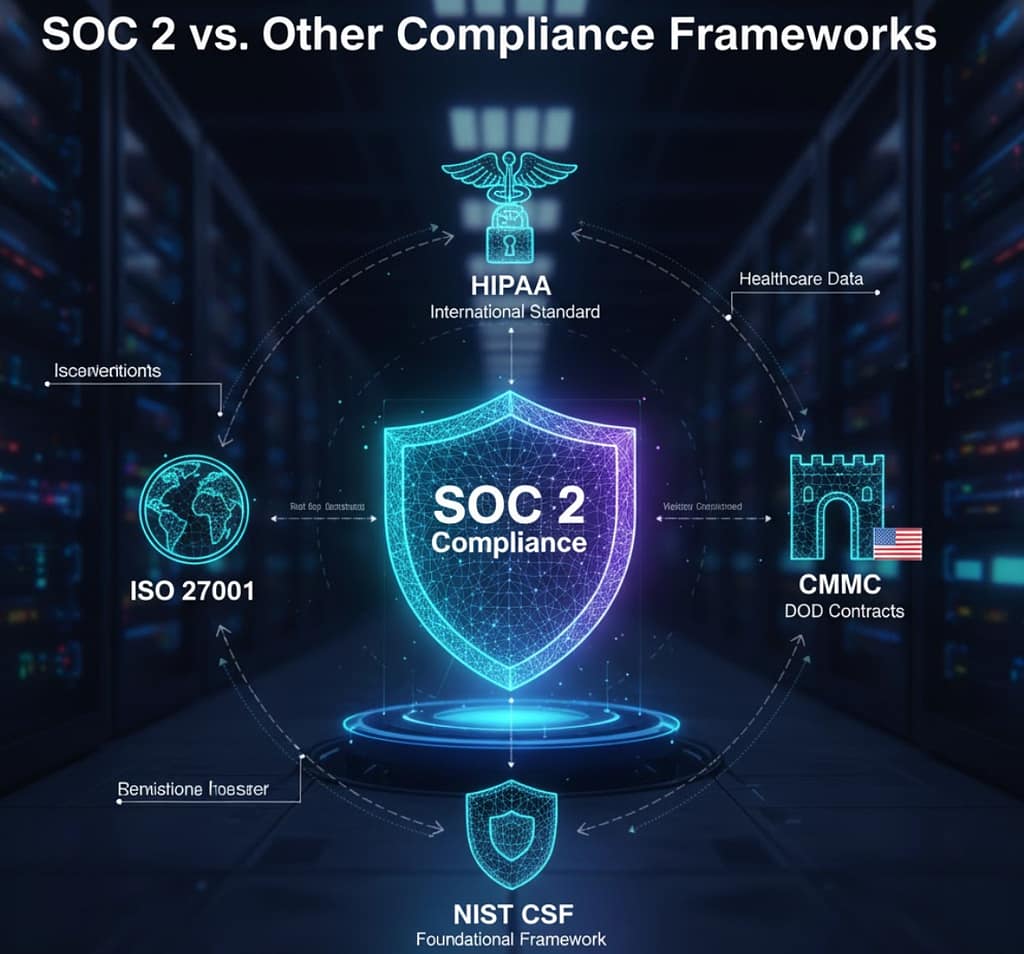
SOC 2 vs. ISO 27001
SOC 2:
- US-focused standard
- Service organization focus
- Customer-facing assurance
- Flexible scope selection
- Private report sharing
ISO 27001:
- International standard
- Applies to any organization
- Certification-based
- Comprehensive security management system
- Public certification listing
Recent updates promote better alignment between SOC 2 and ISO 27001, helping organizations streamline compliance by using unified security controls instead of separate programs.
When to choose both: Companies with international customers often pursue both standards. Read our complete ISO 27001 certification guide for detailed comparison.
SOC 2 vs. CMMC
SOC 2:
- Commercial sector focus
- Customer-driven requirement
- Trust Services Criteria
- No government mandate
CMMC:
- Defense industrial base requirement
- Government-mandated for DOD contracts
- Cybersecurity Maturity Model
- Certification required for contracting
When you need both: Defense contractors serving both government and commercial clients often maintain both certifications. Learn more about CMMC 2.0 compliance timelines and cybersecurity services in San Diego where many defense contractors are located.
SOC 2 vs. HIPAA
SOC 2:
- Voluntary framework
- Broad security and privacy focus
- Independent audit standard
HIPAA:
- Legal requirement for covered entities
- Healthcare-specific regulations
- Government enforcement with penalties
Some SOC 2 requirements are similar to HIPAA requirements—for example, both require data encryption at rest and in transit, and both require access control measures.
When you need both: Healthcare technology companies typically pursue SOC 2 to satisfy commercial customers while maintaining HIPAA compliance for regulatory requirements.
SOC 2 vs. NIST Cybersecurity Framework
While SOC 2 is an audit standard, the NIST Cybersecurity Framework provides a foundational approach to security that many organizations use to prepare for SOC 2. The NIST framework’s five functions (Identify, Protect, Detect, Respond, Recover) align well with SOC 2’s security requirements, making it an excellent starting point for compliance preparation.
Common SOC 2 Challenges and How to Overcome Them
Organizations pursuing SOC 2 certification frequently encounter similar obstacles. Understanding these challenges helps you prepare effectively.
Challenge 1: Resource Constraints
Problem: Small teams struggle to manage normal operations while preparing for SOC 2.
Solution:
- Engage a virtual CISO to lead the compliance effort
- Prioritize high-impact controls first
- Leverage compliance automation platforms
- Outsource specific technical implementations
Challenge 2: Documentation Gaps
Problem: Many organizations find their existing IT policies and procedures have gaps in documentation or workflow.
Solution:
- Use industry templates as starting points
- Document current practices before designing ideal state
- Schedule regular documentation reviews
- Assign clear ownership for each policy
Challenge 3: Evidence Collection
Problem: Type 2 audits require months of evidence that many companies haven’t been collecting.
Solution:
- Implement automated logging and monitoring early
- Create evidence collection schedule and checklist
- Designate specific owners for each evidence type
- Use GRC platforms to centralize evidence management
Challenge 4: Vendor Management
Problem: SOC 2 requires assessing and managing risks associated with vendors and business partners.
Solution:
- Catalog all vendors with access to customer data
- Request SOC 2 reports from critical vendors
- Implement vendor risk assessment process
- Document vendor security requirements in contracts
Challenge 5: Executive Buy-In
Problem: Leadership doesn’t understand ROI of SOC 2 investment.
Solution:
- Quantify revenue impact (deals lost without SOC 2)
- Present competitive analysis showing competitor certifications
- Calculate cost of data breach vs. compliance cost
- Frame SOC 2 as revenue enabler, not just expense
For organizations seeking to demonstrate ROI, our guide on evaluating ROI of cybersecurity consulting provides frameworks for quantifying compliance value to leadership.
Should You Hire a Virtual CISO for SOC 2?
Many organizations leverage virtual CISO (vCISO) services to guide their SOC 2 journey, particularly when internal security expertise is limited. vCISOs typically work on a fractional basis, providing executive-level security leadership without the cost of a full-time hire.
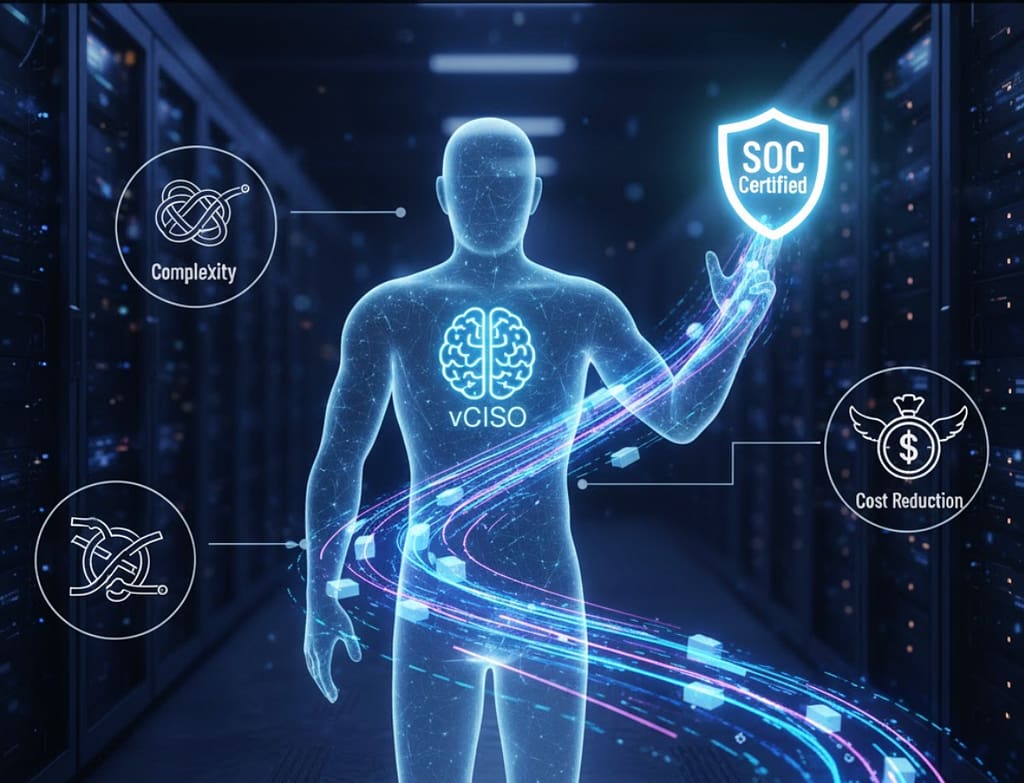
What a vCISO Provides:
Strategic Guidance:
- Determine appropriate scope and TSC selection
- Create realistic timeline and budget
- Identify control gaps and remediation priorities
- Navigate auditor selection
Technical Implementation:
- Design control framework aligned with TSC
- Implement security technologies and processes
- Establish evidence collection procedures
- Create comprehensive policy documentation
Audit Management:
- Serve as primary point of contact with auditors
- Coordinate evidence submission
- Respond to audit inquiries and findings
- Manage remediation of exceptions
Ongoing Support:
- Maintain compliance post-certification
- Prepare for annual re-certification
- Implement continuous improvement practices
- Monitor changing audit standards
Learn more about choosing the right vCISO provider and explore vCISO cost considerations for your organization.
SOC 2 Compliance Timeline
Understanding realistic timelines helps set appropriate expectations with stakeholders and customers.
Type 1 Timeline: 1.5 – 3.5 Months Total
- Weeks 1-2: Readiness assessment and scope definition
- Weeks 3-6: Gap remediation and control implementation
- Weeks 7-8: Policy documentation and preparation
- Weeks 9-12: Formal audit
- Weeks 13-14: Report issuance
Type 2 Timeline: 5.5 – 17.5 Months Total
- Months 1-3: Readiness assessment and gap remediation
- Months 4-15: Observation period (minimum 3 months, typically 6-12 months)
- Months 16-17: Formal audit and report issuance
Factors Affecting Timeline:
The exact timeline depends on your organization’s current security posture, size and complexity, specific Trust Services Criteria included in scope, and resources dedicated to the effort.
Timeline Accelerators:
- Existing strong security foundation
- Dedicated internal resources
- Executive sponsorship and prioritization
- vCISO or consultant guidance
- Compliance automation tools
Timeline Delays:
- Significant control gaps requiring remediation
- Complex multi-environment infrastructure
- Limited internal resources
- Vendor compliance dependencies
- Scope expansion mid-project
Maintaining SOC 2 Compliance
SOC 2 certification isn’t a one-time achievement—it requires ongoing effort to maintain compliance and prepare for annual re-certification.
Annual Re-Certification Requirements:
- Continue operating all audited controls effectively
- Collect evidence throughout the year
- Document any control or system changes
- Undergo annual audit (typically shorter than initial audit)
- Update report for distribution to new customers
Continuous Compliance Activities:
Quarterly:
- Review and update security policies
- Conduct access reviews
- Assess vendor security posture
- Review incident response procedures
Monthly:
- Security awareness training
- Vulnerability scanning and remediation
- Log review and analysis
- Control testing samples
Ongoing:
- Monitor security alerts and respond to incidents
- Collect audit evidence automatically
- Track and approve system changes
- Document exceptions and remediation
Organizations should implement security awareness training programs that go beyond annual compliance requirements to create a culture of security.
Compliance Monitoring Best Practices:
- Designate compliance owner – Assign clear responsibility for maintaining SOC 2
- Implement GRC platform – Automate evidence collection and control testing
- Establish change management – Document all system and control changes
- Conduct internal audits – Quarterly self-assessments identify issues early
- Maintain evidence repository – Organized evidence saves time during annual audits
Next Steps: Your SOC 2 Journey
SOC 2 compliance represents a significant investment of time, money, and resources—but for most B2B technology companies, it’s essential for business growth and customer trust.
Recommended Action Plan:
Step 1: Assess Your Readiness Conduct an internal gap analysis against the Security criterion to understand your starting point.
Step 2: Determine Your Timeline Based on business needs (customer requirements, sales pipeline), decide whether you need Type 1 or Type 2 certification and by when.
Step 3: Secure Resources Calculate budget requirements and determine whether to pursue SOC 2 with internal resources, automation tools, vCISO support, or a combination.
Step 4: Choose Your Auditor Research AICPA-certified CPA firms with SOC 2 specialization in your industry and organization size.
Step 5: Execute Your Plan Follow the 90-day implementation roadmap or engage expert guidance to accelerate your journey.
Get Expert Help
Blue Radius specializes in helping technology companies achieve SOC 2 compliance through virtual CISO services and strategic security guidance. Our team has guided dozens of organizations through successful SOC 2 certifications, from early-stage startups to established enterprises.
We can help you:
- Conduct SOC 2 readiness assessments
- Build compliant control frameworks
- Implement required security controls
- Manage the audit process from start to finish
- Maintain ongoing compliance post-certification
Contact us to discuss your SOC 2 goals and learn how virtual CISO services can accelerate your compliance journey while reducing costs and complexity.
About Blue Radius
Blue Radius provides virtual CISO services and cybersecurity consulting to growing technology companies across the United States. We serve clients in Austin, San Diego, Seattle, Boston, Chicago, and beyond. Our expert team helps organizations achieve SOC 2, ISO 27001, and CMMC compliance while building robust security programs that scale with business growth. Learn more at blueradius.io or explore our cybersecurity consulting services.
Frequently Asked Questions
Q: Is SOC 2 certification mandatory? A: No, SOC 2 is voluntary. However, many enterprise customers and regulated industries require it from their vendors.
Q: How long is a SOC 2 report valid? A: SOC 2 reports are valid for 12 months. Organizations must undergo annual re-certification to maintain compliance.
Q: Can I share my SOC 2 report publicly? A: No, SOC 2 reports are confidential and should only be shared under NDA with customers and stakeholders who have a legitimate business need.
Q: What’s the difference between SOC 1, SOC 2, and SOC 3? A: SOC 1 focuses on financial reporting controls. SOC 2 addresses security, availability, and privacy controls. SOC 3 is a summarized, public version of SOC 2.
Q: Do I need all five Trust Services Criteria? A: No. Security is mandatory, but the other four criteria are optional based on your services and customer requirements.
Q: Can I get SOC 2 certified without hiring a consultant? A: Yes, many companies pursue SOC 2 independently. However, vCISO or consultant guidance typically reduces timeline, costs, and audit failures.

Jeff Sowell is a cybersecurity leader with over 20 years of experience in IT and security roles at Fortune 500 companies. He has held key positions such as VP, CISO, and CPSO, serving as Head of Product Security at Ericsson North America. Jeff holds an M.S. in Computer Information Systems (Security) from Boston University and industry-recognized certifications including CISSP, CISM, and ISO 27001 Lead Implementor.
Related from the BlueRadius Library
Sourced posts on adjacent topics, ranked by tag overlap.
Compliance
ISO 27001 vs SOC 2: Which Compliance Framework Does Your Company Need? (2026)
ISO 27001 vs SOC 2 compared: certification vs attestation, the shared control core, how to choose, and whether to pursue both. A 2026 mid-market guide.
ReadCompliance
PCI DSS 4.0.1 Compliance: A Mid-Market Guide for 2026
A PCI DSS 4.0.1 compliance guide for mid-market companies: merchant levels, SAQ selection, what changed in 4.0, and a step-by-step readiness checklist.
ReadCompliance
HIPAA Breach Report 2026: OCR Data, Ransomware Trends, and What Mid-Market Healthcare Must Do Next
Factual 2024 HIPAA breach analysis: 276 million records exposed, 725 OCR-reported breaches, and Change Healthcare at 190 million. Fully sourced.
ReadCompliance
SEC Cybersecurity Disclosure Rules: What Mid-Market Companies Need to Know in 2026
How SEC cybersecurity disclosure rules affect mid-market companies. Four-day reporting, board oversight, and what to prepare now.
ReadCompliance
McLean FedRAMP Compliance Services: Authorization for Government Cloud
McLean VA companies seeking FedRAMP authorization: expert guidance from readiness assessment to P-ATO and ATO for government cloud services.
ReadCompliance
San Diego Defense Contractor CMMC Compliance: A Complete Guide
San Diego defense contractors: achieve CMMC Level 2 compliance with guidance on CUI protection, NIST 800-171 controls, and certification.
ReadRelated services