How MSPs & Consultants Add SOC 2 Services Without Hiring GRC Staff
Quick Summary
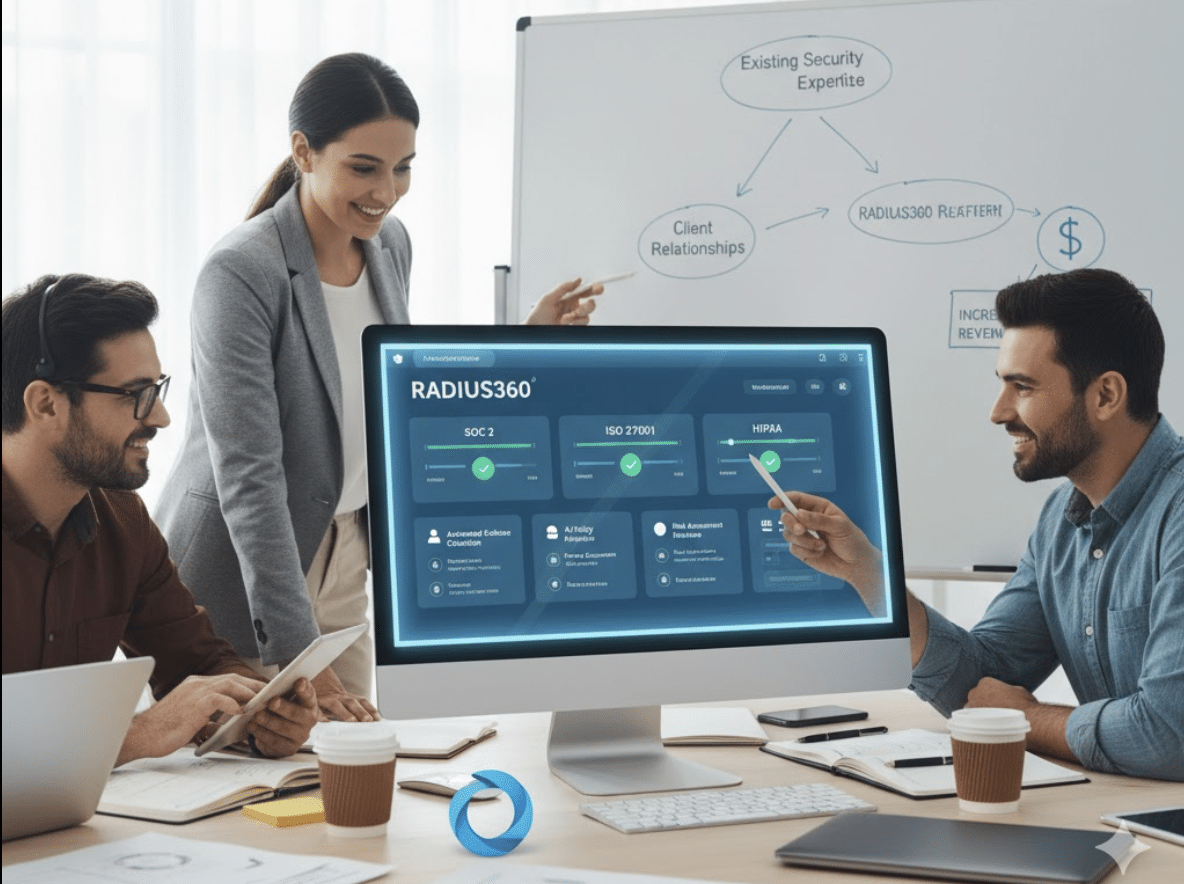
MSPs and independent security consultants can add significant compliance revenue without hiring GRC specialists.
What You Need:
- Existing security expertise ✓
- Client relationships (or ability to build them) ✓
- Compliance platform (Radius360 starts at $936/year)
- 40-60 hours for first implementation
Revenue Potential:
- SOC 2 services: Market rates $35K-$55K initial + ongoing retainers
- ISO 27001: Market rates $45K-$70K initial + ongoing retainers
- 5-10 clients = $200K-$600K additional annual revenue potential
Timeline: 3 months from evaluation to first client delivery
Who This Serves: Managed service providers, independent security consultants, fractional CISOs, and boutique consulting firms
Introduction
Managed service providers and independent security consultants consistently hear client requests for SOC 2 certification, ISO 27001 compliance, and HIPAA requirements. These compliance services represent substantial revenue opportunities, yet many service providers refer these projects to specialized consultants, leaving recurring revenue on the table.
The traditional barrier has been expertise. Delivering compliance services typically required hiring GRC (Governance, Risk, and Compliance) specialists at $120,000-$180,000 annually*, investing significant time in staff training, or maintaining expensive consultant relationships.
Source: Based on Glassdoor salary data for GRC Analyst roles, January 2025. Actual compensation varies by geography and experience.
This guide demonstrates how MSPs and independent consultants can add compliance services using platform-enabled delivery—leveraging tools like Radius360 that handle framework structure and evidence automation while you provide client relationships and security expertise.
What you’ll learn:
- Why compliance represents a major revenue opportunity for service providers
- Platform-enabled delivery vs. traditional approaches
- How to deliver SOC 2, ISO 27001, and HIPAA compliance
- Revenue models for both MSPs and solo practitioners
- Getting started without significant upfront investment
Who This Guide Serves
This guide provides implementation guidance for service providers adding compliance services:
Managed Service Providers (MSPs): Adding compliance to existing IT/security portfolios, leveraging established client relationships, building recurring revenue streams.
Independent Security Consultants: Expanding from advisory to compliance delivery, professionalizing service with compliance platforms, scaling beyond manual implementations.
Fractional CISOs (vCISOs): Adding compliance implementation to strategic advisory, using platforms to scale to 5-10 concurrent clients, increasing revenue per engagement.
Boutique Consulting Firms: Standardizing delivery across consultants, scaling beyond founder-led implementations, building repeatable compliance practices.
The platform-enabled delivery model applies to all provider types. Core approach—leveraging Radius360 for framework structure while you provide expertise—remains consistent. Service provider-specific considerations addressed in dedicated section below.
Why Compliance Is the Next Revenue Stream
Growing Client Demand
Clients face increasing compliance pressure:
Customer Requirements: Enterprise customers require SOC 2 Type II before contracts. International customers request ISO 27001. Healthcare partnerships demand HIPAA compliance.
Insurance Requirements: Cyber insurance carriers increasingly require documented security controls, often referencing SOC 2 or ISO 27001 frameworks.
Regulatory Pressure: Industry-specific regulations (HIPAA for healthcare, PCI DSS for payment processing, CMMC for defense contractors) create mandatory compliance obligations.
Competitive Positioning: Compliance certifications have become expected for B2B SaaS companies seeking enterprise customers or venture capital funding.
For context on how managed security services relate to compliance delivery, our MSSP overview provides additional perspective.
Service Providers Are Well-Positioned
Trust Relationships: MSPs maintain ongoing client relationships. Independent consultants build trust through engagements. Both enable natural compliance service expansion.
Security Knowledge Foundation: Service providers understand firewalls, encryption, access controls, and monitoring—the technical foundation of compliance frameworks.
Implementation Capabilities: Unlike pure auditors, service providers implement technical solutions—exactly what clients need for gap remediation.
Recurring Revenue Alignment: Compliance isn’t one-time. Annual audits, continuous monitoring, and framework updates create predictable revenue for MSPs and long-term engagements for consultants.
Market Opportunity
Based on market research of compliance service pricing*:
SOC 2 Type II Services:
- Initial certification: Market rates $30,000-$60,000
- Ongoing annual support: Market rates $24,000-$48,000 (recurring)
ISO 27001 Services:
- Initial certification: Market rates $40,000-$80,000
- Annual recertification: Market rates $30,000-$50,000 (recurring)
HIPAA Compliance:
- Initial assessment: Market rates $25,000-$50,000
- Ongoing management: Market rates $18,000-$36,000 annually (recurring)
Pricing based on published rate cards from compliance consulting firms and market research, January 2025. Actual pricing varies by company size, industry, and geography.
For MSPs: 10 compliance clients = $300,000-$600,000 additional annual revenue potential.
For Independent Consultants: 3-5 active clients = $150,000-$300,000 annual revenue potential.
The Traditional Barriers
Option 1: Hire GRC Specialists
Full-Time GRC Analyst:
- Salary: $90,000-$140,000 (per Glassdoor, January 2025)
- Benefits (30%): $27,000-$42,000
- Training: $5,000-$10,000 annually
- Total: $122,000-$192,000 annually
For MSPs: Need 3-5 clients to justify one hire. Most lack initial volume.
For Consultants: Economically impossible. Solo practitioners can’t support $120K+ overhead.
Option 2: Develop Deep GRC Expertise
Time investment: 6-12 months for certifications (CISSP, CISA, ISO 27001 Lead Implementer).
Certification costs: $3,000-$8,000 per person.
Opportunity cost: 6-12 months not generating revenue while developing expertise.
Option 3: Partner with Consultants
Consultant rates: $200-$400 per hour or $30,000-$80,000 per project based on market research*.
Margin erosion: If charging clients $50,000 but paying subcontractors $40,000, margin is minimal.
Client relationship risk: External consultants interact directly with clients, creating potential bypass.
Based on published hourly rates from mid-sized compliance consulting firms, January 2025.
The Core Challenge
Traditional approaches require significant upfront investment, ongoing costs consuming margin, or resource constraints preventing scaling.
Service providers need compliance capabilities without proportional cost increases—which is where platform-enabled delivery becomes relevant.
Platform-Enabled Compliance Delivery
The Platform Approach
Modern GRC platforms automate technical aspects:
Evidence Collection: Automated integration with infrastructure (AWS, Azure, Google Cloud, Okta, GitHub) continuously collects control evidence.
Framework Mapping: Pre-built controls for SOC 2, ISO 27001, HIPAA eliminate manual documentation.
Risk Assessment: Guided workflows with templates reduce risk identification from weeks to days.
Policy Generation: AI-powered creation generates customized policies based on client contexts.
Audit Preparation: Centralized repositories and automated mapping streamline audit preparation.
Continuous Monitoring: Real-time alerts when configurations drift from compliance.
What Service Providers Deliver
Strategic Guidance: Interpreting framework requirements for specific business contexts. Platforms provide structure; you provide judgment.
Risk Assessment Facilitation: Leading stakeholder workshops through risk identification processes.
Gap Remediation: Implementing technical fixes—which security professionals already do.
Vendor Management: Evaluating third-party security for vendor risk assessments.
Auditor Communication: Managing auditor relationships and responding to inquiries.
Ongoing Monitoring: Reviewing automated alerts and ensuring continuous compliance.
These leverage core competencies—security knowledge, client communication, technical implementation—without requiring deep GRC specialization.
Why This Model Works
Leverage existing capabilities: Your security knowledge provides foundation. Compliance platform provides framework structure and automation.
Scale efficiently:
- MSPs: One platform serves multiple clients. Incremental cost minimal.
- Consultants: Platform enables 3-5 concurrent engagements vs. 1-2 with manual approaches.
Professional experience: Clients access professional dashboards rather than spreadsheets.
Faster time-to-revenue: Start delivering immediately rather than spending 6-12 months developing expertise.
For context on how strategic leadership complements services, see our vCISO and MSSP integration guide.
How to Deliver with Radius360
Full Disclosure: Radius360 is built and operated by BlueRadius Cyber. We’re discussing it because we designed it for practitioners—including MSPs and consultants—who need efficient compliance service delivery. We acknowledge our bias as creators.
Why Radius360 for Service Providers
Practitioner-Built: Created by vCISOs delivering compliance services professionally, addressing real-world challenges.
Multi-Framework Architecture: Evidence collected once maps automatically to SOC 2, ISO 27001, HIPAA, NIST CSF, PCI DSS, and other frameworks. Avoid duplicated effort.
Transparent Pricing: Starting at $936 annually (Solo tier documented on website), enabling accurate cost modeling.
AI-Powered Policies: Reduces policy development time significantly, making deliverables economically viable.
Risk Visualization: Interactive heatmaps and matrices provide professional risk presentations.
Client Portal: Professional dashboards clients access independently, eliminating “consultant spreadsheet” problem.
Early Access Status: Recently launched. Service providers benefit from direct practitioner support. As newer platform, expect ongoing development.
Service Delivery Workflow
Phase 1: Client Discovery (2-4 hours)
- Determine frameworks required (SOC 2, ISO 27001, HIPAA)
- Document timeline and business drivers
- Assess current security posture
- Identify technology stack requirements
- Configure Radius360 instance
Phase 2: Gap Assessment (4-8 hours)
- Review controls against current state
- Automated evidence collection for existing controls
- Identify remediation gaps
- Generate prioritized roadmap
- Present findings with timeline estimates
Phase 3: Evidence Collection Setup (2-4 hours)
- Integrate Radius360 with client systems
- Configure automated collection schedules
- Test control monitoring
Phase 4: Policy Development (4-6 hours)
- Generate customized policies using AI
- Review and refine content
- Obtain client approval
- Distribute to employees
Phase 5: Gap Remediation (Variable)
- Configure MFA, encryption, logging
- Implement access controls
- Deploy monitoring
- Document implementation
Phase 6: Risk Assessment (4-8 hours)
- Facilitate stakeholder workshops
- Document identified risks
- Score using impact/likelihood matrix
- Assign mitigation owners
- Generate risk register
Phase 7: Audit Preparation (6-10 hours)
- Review evidence completeness
- Generate audit-ready documentation
- Brief client on process
- Coordinate auditor access
- Respond to inquiries
Phase 8: Ongoing Monitoring (2-4 hours monthly)
- Review compliance alerts
- Update evidence as systems change
- Conduct quarterly reviews
- Maintain policy currency
- Prepare for recertification
Implementation Time
First-time SOC 2 certification: ~40-60 hours professional time over 3-4 months
Annual recertification: ~15-25 hours professional time
These hours represent strategic guidance. Radius360 handles automated evidence collection, framework mapping, and documentation generation.
For strategic security leadership understanding, see What is a Virtual CISO?
Revenue Model & Pricing
Service Pricing Structure
Based on market research*:
Project-Based Initial Certification:
SOC 2 Type II: Market rates $35,000-$55,000 (3-4 months, includes gap assessment, remediation, policies, audit prep)
ISO 27001: Market rates $45,000-$70,000 (4-6 months, includes ISMS documentation, risk assessment, certification prep)
HIPAA: Market rates $25,000-$45,000 (2-3 months, includes risk analysis, policies, technical controls)
Retainer-Based Ongoing:
Annual Management: Market rates $3,000-$6,000 monthly ($36,000-$72,000 annually) for continuous monitoring, evidence management, quarterly reviews, audit support.
Hybrid Model (Recommended): Project-based initial certification + monthly retainer ongoing + discounted recertifications. Maximizes initial revenue while establishing predictable recurring income.
Pricing based on published rate cards from compliance consulting firms and market research, January 2025. Varies by company size, complexity, geography.
Cost Structure
Platform Costs:
- Radius360: Solo tier $936/year (documented). Contact for volume/partnership pricing.
- MSPs: Scales with client instances
- Consultants: Solo tier adequate for 1-2 clients
Professional Labor:
- Internal cost (MSPs): $100-$150/hour typical
- Billable rate (Consultants): $200-$350/hour market rates
- Initial certification: 40-60 hours
- Ongoing: 2-4 hours monthly
External Costs:
- Audit fees: Client-paid (not provider cost)
- Penetration testing: Subcontractable with 20-30% markup
Margin Examples
Example 1: MSP with 10 Clients (Hypothetical)
Per client annually:
- Revenue: $45K initial + $48K retainer = $93K
- Costs: ~$2K platform + $10K labor = ~$12K
- Potential margin: ~$81K per client
At 10 clients: ~$810K potential annual gross profit
Example 2: Independent Consultant with 3-5 Clients (Hypothetical)
Per client annually:
- Revenue: $45K initial + $12K support = $57K
- Costs: ~$936 platform + $17.5K self-cost labor = ~$18.4K
- Net income: ~$38.6K per client
At 3-5 clients: $115K-$193K potential annual income
Hypothetical examples for illustration. Actual results vary significantly by pricing, efficiency, market conditions, circumstances.
Client Lifetime Value
Typical engagement (hypothetical):
- Initial: $45K
- Year 2-3: $24K-$48K annually
- 3-year value: $93K-$141K per client
Multi-framework adds $78K over 3 years.
For service economics context, see our vCISO cost analysis.
What You Need to Get Started
Existing Capabilities
Security Knowledge:
- Firewalls, encryption, access controls
- MFA, monitoring, logging implementation
- Cloud security (AWS, Azure, GCP)
- Vulnerability management
Client Interaction:
- MSPs: Trusted advisor relationships
- Consultants: Workshop facilitation abilities
- Both: Professional communication
Technical Implementation:
- Security control configuration
- Integration and automation experience
- Documentation discipline
These are standard capabilities. Compliance delivery builds on this foundation.
New Capabilities to Develop
Framework Knowledge:
- SOC 2 Trust Service Criteria understanding
- ISO 27001 control categories
- HIPAA Security Rule safeguards
- Training available through Radius360 and industry resources
Risk Assessment Facilitation:
- Stakeholder workshop leadership
- Structured risk documentation
- Risk scoring guidance
Auditor Communication:
- Audit process understanding
- Professional inquiry responses
- Timeline management
Policy Development:
- AI-generated policy review
- Ensuring policy-practice alignment
- Approval workflow management
- Simplified by Radius360’s AI
Training and Support
Radius360 Onboarding:
- Platform training
- Framework guidance
- Practitioner best practices
- Implementation support
Industry Certifications (Optional):
- CISA (Certified Information Systems Auditor)
- ISO 27001 Lead Implementer
- CISSP with GRC focus
Certifications enhance credibility but aren’t prerequisites.
Tools and Infrastructure
Required:
- Radius360 platform access
- Communication tools (video, email)
- Documentation repository
MSP-Specific:
- Ticketing/project management systems
- Client portal infrastructure
Consultant-Specific:
- Professional templates
- Contract/SOW templates
- Business insurance (E&O)
Most infrastructure exists or is easily obtained.
Three-Month Implementation Roadmap
Month 1: Foundation
Week 1-2: Platform Evaluation
- Book Radius360 demo to see workflows
- Evaluate fit for service model
- Understand pricing and deployment
- Schedule consultation to discuss opportunities
Week 3: Service Definition
- Define frameworks offered (SOC 2, ISO 27001, HIPAA)
- Create packages and pricing
- Develop client-facing descriptions
- Build delivery processes
Week 4: Preparation
- MSPs: Select 1-2 engineers for focus
- Consultants: Complete platform training
- Review framework basics
- Practice with demos
Month 2: First Client
Week 1: Client Acquisition
- MSPs: Identify pilot from existing clients
- Consultants: Leverage network, audit firm relationships, LinkedIn outreach
- Present offering
- Secure engagement
Week 2-4: Implementation
- Execute discovery and gap assessment
- Configure Radius360
- Deliver findings
- Begin remediation
Document: time spent, challenges, questions, improvements.
Month 3: Refinement and Expansion
Week 1-2: Pilot Completion
- Complete implementation
- Calculate actuals vs. projections
- Gather feedback
- Refine processes
Week 3-4: Pipeline Development
- MSPs: Approach 3-5 additional clients
- Consultants: Develop referral relationships, continue outreach
- Build case study
- Standardize pricing
Ongoing: Scale
- Train additional team (if applicable)
- Build audit firm partnerships
- Consider dedicated marketing
- Add compliance services to standard offerings
Service Provider-Specific Guidance
While core delivery remains consistent, implementation differs by provider type:
For Managed Service Providers:
- Advantage: Existing client relationships reduce acquisition costs
- Strategy: Audit current clients for needs, bundle with IT services
- Pricing: Competitive initial pricing, focus on recurring revenue
- Scaling: Start 2-3 pilots, train engineers as volume grows
For Independent Consultants:
- Advantage: Premium rates ($250-$350/hr), 100% revenue retention
- Strategy: Partner with audit firms, LinkedIn outreach, free gap assessments
- Pricing: Hourly or project-based, consider retainers for stability
- Scaling: 3-5 concurrent clients typical, use platform to increase capacity
- Infrastructure: LLC formation, E&O insurance, contract templates essential
For Fractional CISOs:
- Advantage: Strategic relationship enables premium positioning
- Strategy: Upsell existing vCISO clients as natural expansion
- Pricing: $300-$400/hr justified by strategic context
- Scaling: Serve 3-8 clients, delegate execution while maintaining oversight
For Boutique Firms:
- Advantage: Team capacity enables concurrent engagements
- Strategy: Standardize delivery across consultants using platform
- Pricing: Blended rates (junior $150/hr, senior $350/hr)
- Scaling: Platform enables consistent quality across team
For detailed vCISO guidance, see virtual CISO services overview and vCISO implementation guide.
Frequently Asked Questions
Can providers deliver compliance services without GRC certifications?
Yes. While certifications like CISA or ISO 27001 Lead Implementer enhance credibility, they aren’t mandatory for platform-enabled delivery. Many providers successfully deliver using existing security expertise and platform guidance, adding certifications as practices mature.
Focus on quality outcomes. Clients care about achieving certification more than specific credentials, though certifications help with confidence.
How much do consultants charge for SOC 2 compliance services?
Based on market research, independent consultants typically charge:
Hourly Rates: $200-$300/hr (mid-level), $300-$400/hr (senior), varies by geography and experience
Project-Based: SOC 2 implementation $35,000-$60,000, ISO 27001 $45,000-$70,000, ongoing support $3,000-$6,000/month or hourly
MSPs may price similarly or offer bundled packages. Actual pricing varies by market, complexity, positioning.
What if clients need services beyond our expertise?
Partner for capabilities outside core competencies:
Penetration Testing: Subcontract to specialized firms with 20-30% markup
Legal Policy Review: Partner with compliance attorneys for highly regulated industries
Complex Situations: Consider engaging BlueRadius vCISO services for oversight
Audit Firm Selection: Maintain relationships with 2-3 audit firms for referrals
Neither MSPs nor consultants need every component in-house. Orchestrating comprehensive programs while delivering core implementation provides value.
How do independent consultants compete with established firms?
You’re serving different markets:
Large Firms: Target enterprise ($100M+ revenue), pricing $200K-$500K+, value brand assurance
Independent Consultants: Target small to mid-market ($5M-$50M), pricing $50K-$150K, value cost-effectiveness, personalized attention, flexibility
Your advantages: lower overhead enables competitive pricing, direct client access, faster decisions, specialized expertise vs. generalist approaches.
Can one person manage multiple compliance clients simultaneously?
Yes, with platform-enabled delivery:
Without platforms: 1-2 concurrent clients maximum (manual evidence collection, spreadsheet management)
With Radius360: 3-5 concurrent clients comfortable (automated evidence, standardized workflows)
Keys to managing multiple clients: Stagger implementations, use automation for monitoring, set clear boundaries, build templates for recurring deliverables.
Many successful solo practitioners maintain 3-5 active clients generating $150K-$300K annually.
How do MSPs price compliance services compared to IT services?
Traditional IT Services: Monthly recurring (per-user/device), fixed retainers, break-fix hourly
Compliance Services: Project-based initial certification, monthly retainer ongoing, higher hourly rates ($150-$250/hr vs. $100-$150/hr)
Compliance services often generate higher margins (80-85%) than traditional IT services (30-50%) due to automation and specialized expertise value.
How long until I can start generating revenue from compliance services?
Realistic timeline:
Month 1: Platform evaluation, training, service definition (no revenue)
Month 2: First client signed, implementation begins (initial payment or hourly billing starts)
Month 3-4: First certification complete (final project payment)
Month 4+: Ongoing retainer revenue begins
First significant revenue: Typically Month 2-4 depending on payment terms
Consistent revenue stream: 6-9 months after starting (multiple clients in various stages)
This is faster than hiring/training approach (12+ months) but requires dedicated effort during first 90 days.
Conclusion
Compliance services represent significant recurring revenue opportunity for MSPs, independent security consultants, fractional CISOs, and boutique consulting firms. Platform-enabled delivery using tools like Radius360 allows service providers to leverage existing security capabilities while automating framework structure and evidence collection.
Key points:
- Substantial market opportunity in SOC 2, ISO 27001, and HIPAA compliance
- Platform-enabled delivery provides professional capabilities without hiring GRC specialists
- Applicable to MSPs, independent consultants, vCISOs, and boutique firms
- Leverage existing security expertise and client relationships
- Capture revenue currently lost to specialist consultants
Getting started requires:
- Platform evaluation and training (2-4 weeks)
- One pilot client engagement (2-3 months)
- Process refinement based on experience
- Systematic expansion as capability develops
Most successful practices begin with 1-2 clients, prove delivery capability, and systematically expand their compliance service offerings.
Next Steps
Interested in adding compliance services to your practice?
We’re supporting MSPs, independent consultants, and vCISO practices in delivering SOC 2, ISO 27001, and HIPAA compliance using Radius360 as their implementation platform.
Evaluate Platform Fit:
- Book Radius360 Demo – See workflows for your service model
- Schedule Free Consultation – Discuss your specific situation
- Review our virtual CISO services for complex engagement support
Questions? Contact BlueRadius Cyber to discuss opportunities, pricing, and implementation support for your service model.
BlueRadius provides both the platform (Radius360) and optional vCISO services for situations requiring additional expertise.
Additional Resources:
- vCISO and MSSP Integration Guide – How strategic and managed services complement each other
- What is a Virtual CISO? – Understanding strategic security leadership
- Managed Security Services Provider Overview – MSSP service models
- ISO 27001 Certification Guide – Framework implementation details
- SOC 2 Compliance Guide – SOC 2 Type II preparation
- NIST Framework for Small Business – NIST CSF implementation
- vCISO Cost Analysis – Understanding service pricing models
Related from the BlueRadius Library
Sourced posts on adjacent topics, ranked by tag overlap.
Compliance
ISO 27001 vs SOC 2: Which Compliance Framework Does Your Company Need? (2026)
ISO 27001 vs SOC 2 compared: certification vs attestation, the shared control core, how to choose, and whether to pursue both. A 2026 mid-market guide.
ReadCompliance
PCI DSS 4.0.1 Compliance: A Mid-Market Guide for 2026
A PCI DSS 4.0.1 compliance guide for mid-market companies: merchant levels, SAQ selection, what changed in 4.0, and a step-by-step readiness checklist.
ReadCompliance
HIPAA Breach Report 2026: OCR Data, Ransomware Trends, and What Mid-Market Healthcare Must Do Next
Factual 2024 HIPAA breach analysis: 276 million records exposed, 725 OCR-reported breaches, and Change Healthcare at 190 million. Fully sourced.
ReadCompliance
SEC Cybersecurity Disclosure Rules: What Mid-Market Companies Need to Know in 2026
How SEC cybersecurity disclosure rules affect mid-market companies. Four-day reporting, board oversight, and what to prepare now.
ReadCompliance
McLean FedRAMP Compliance Services: Authorization for Government Cloud
McLean VA companies seeking FedRAMP authorization: expert guidance from readiness assessment to P-ATO and ATO for government cloud services.
ReadCompliance
San Diego Defense Contractor CMMC Compliance: A Complete Guide
San Diego defense contractors: achieve CMMC Level 2 compliance with guidance on CUI protection, NIST 800-171 controls, and certification.
ReadRelated services