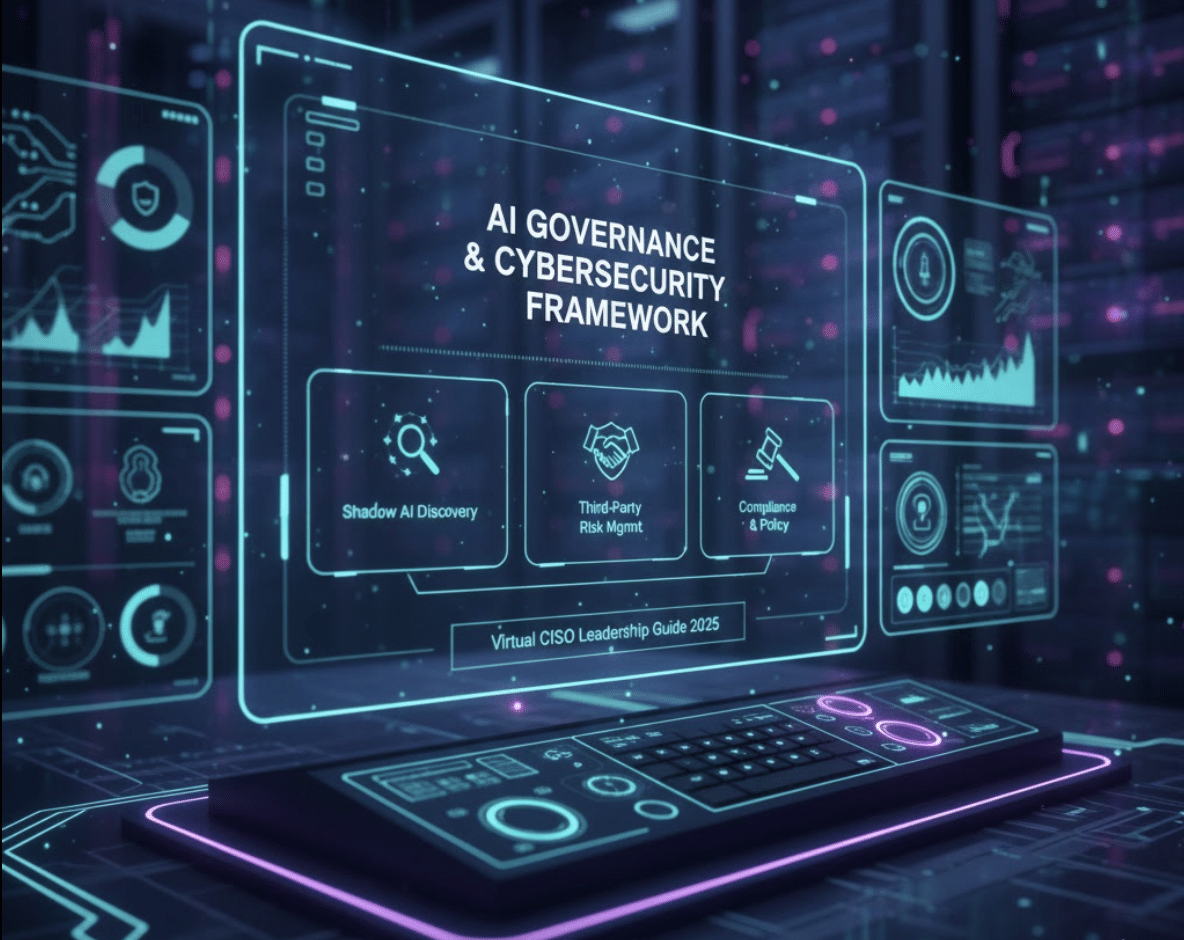
AI Governance & Cybersecurity Framework: Virtual CISO Leadership Guide for 2025
Introduction: AI Governance – The New Frontier for Cybersecurity Leadership
Artificial intelligence has transformed from a futuristic concept to a business-critical technology that’s reshaping how organizations operate. However, with this transformation comes unprecedented cybersecurity challenges that demand strategic leadership. CISOs are now in the hot seat and must try to get their hands around both the ‘risk vs. reward’ and the materiality of risk when it comes to AI tools.
As a business leader, you’re likely facing questions about AI governance that didn’t exist just two years ago: How do we ensure our AI tools don’t expose sensitive data? What happens when employees use unauthorized AI platforms? How do we balance innovation with security?
This comprehensive guide provides a Virtual CISO framework for establishing robust AI governance that protects your organization while enabling innovation.
The Current AI Governance Landscape: What Business Leaders Need to Know
The Shadow AI Challenge
Organizations are struggling to navigate unauthorized AI use. According to Google Cloud’s Office of the CISO, despite predictions that organizations should get ahead of shadow AI, enterprises continue to struggle with employees using unauthorized AI tools without IT oversight.
Key Statistics:
- 70% of CISOs believe a material cyberattack is likely in the next year (Gracker.ai, 2025)
- Only 18% of security leaders prioritize “avoid breaches at all costs” while 30% focus on building security for competitive advantage (PwC, 2023)
- AI technologies are increasingly scrutinized as third-party risks by cybersecurity buyers
Why Traditional Cybersecurity Frameworks Fall Short
Traditional cybersecurity frameworks weren’t designed for AI’s unique characteristics:
Data Flow Complexity: AI systems process vast amounts of data across multiple environments, creating new attack vectors that traditional perimeter security can’t address.
Dynamic Risk Profile: Unlike static applications, AI models evolve through training, creating risks that change over time.
Supply Chain Dependencies: Most business AI tools rely on large language models (LLMs) from third-party providers, introducing vendor risk management challenges.
Regulatory Uncertainty: AI governance regulations are evolving rapidly, requiring adaptive compliance strategies.
Virtual CISO AI Governance Framework: A Strategic Approach
Phase 1: AI Asset Discovery and Risk Assessment
Comprehensive AI Inventory
The first step in AI governance is understanding what AI tools your organization currently uses:
Sanctioned AI Tools:
- Enterprise AI platforms (Microsoft Copilot, Google Workspace AI)
- Industry-specific AI solutions
- Custom AI applications
- AI-powered security tools
Shadow AI Discovery:
- Employee surveys about AI tool usage
- Network traffic analysis for AI platform connections
- Browser extension and software audits
- Cloud application discovery tools
Risk Categorization Matrix:
| Risk Level | Data Sensitivity | Business Impact | Regulatory Scope |
|---|---|---|---|
| Critical | PII, PHI, Financial | Core business operations | Highly regulated industries |
| High | Confidential business data | Important workflows | Moderate compliance requirements |
| Medium | Internal communications | Supporting functions | Limited regulatory oversight |
| Low | Public information | Non-critical tasks | No compliance implications |
Phase 2: AI Risk Management Strategy
Data Protection Controls
Input Sanitization: Establish protocols for what data can and cannot be shared with AI tools:
- Customer personal information restrictions with clear data classification standards
- Proprietary business strategy limitations
- Intellectual property protections
- Compliance data handling requirements aligned with regulatory compliance frameworks
Output Validation: Implement controls for AI-generated content:
- Accuracy verification processes
- Bias detection and mitigation protocols
- Brand consistency standards
- Legal review requirements for external communications
Vendor Risk Assessment
Third-Party AI Tool Evaluation:
- Data residency and sovereignty requirements
- Encryption standards for data in transit and at rest
- Vendor security certifications (SOC 2, ISO 27001, FedRAMP)
- Incident response and breach notification procedures
- Data retention and deletion policies
Supply Chain Security Questions:
- How is the AI model trained and with what data?
- What security controls protect the training infrastructure?
- How are model updates and patches deployed?
- What happens to our data after processing?
Phase 3: Policy Development and Implementation
AI Acceptable Use Policy
Approved AI Tools List:
- Enterprise-sanctioned platforms with proper security controls
- Approved use cases for each tool
- Data classification guidelines
- Training requirements for users
Prohibited AI Activities:
- Uploading sensitive customer data to unsanctioned platforms
- Using AI for decisions that require human judgment (hiring, performance reviews)
- Generating content that could violate intellectual property rights
- Processing regulated data without proper controls
Incident Response Procedures
AI-Specific Incident Categories:
- Unauthorized data sharing with AI platforms
- AI-generated content containing sensitive information
- Bias-related incidents in AI decision-making
- AI system compromise or manipulation
Response Protocols:
- Immediate containment procedures
- Data impact assessment
- Regulatory notification requirements
- Communication strategies for stakeholders
Emerging AI Compliance Frameworks: 2025 Regulatory Landscape
EU AI Act: Global Impact on Business AI Governance
Implementation Timeline and Requirements
The European Union’s Artificial Intelligence Act, which began enforcement in August 2024, continues to influence global AI governance standards throughout 2025. Even non-EU companies must comply if they offer AI services to EU customers or use AI systems that could affect EU residents.
2025 Key Compliance Milestones:
- February 2025: Prohibited AI systems ban fully in effect
- August 2025: High-risk AI systems must implement comprehensive compliance measures
- May 2025: Foundation model transparency requirements enforcement begins
- Ongoing: General-purpose AI model obligations for providers above computational thresholds
High-Risk AI Systems (Full Compliance Required by August 2025):
- AI used in recruitment and employment decisions
- AI for credit scoring and loan approval
- AI in healthcare diagnostics and treatment
- AI for law enforcement and border control
- AI in education and training assessments
- AI systems for critical infrastructure management
Compliance Obligations:
- Fundamental rights impact assessments before deployment
- Risk management systems documentation with regular updates
- Data governance and quality standards implementation
- Transparency and human oversight requirements with audit trails
- Accuracy and robustness testing protocols with performance metrics
Business Impact: Organizations using AI for customer-facing applications, HR processes, or financial services must implement comprehensive governance frameworks that meet EU standards, regardless of their physical location. Failure to comply can result in fines up to €35 million or 7% of annual global turnover, whichever is higher.
NIST AI Risk Management Framework (AI RMF 1.0) – 2025 Updates
Framework Overview and Recent Developments
The National Institute of Standards and Technology’s AI Risk Management Framework provides a structured approach to managing AI risks across the AI lifecycle. In early 2025, NIST announced plans for AI RMF 2.0, which will include enhanced guidance for generative AI and large language models, scheduled for release in late 2025.
Current Framework – Four Core Functions:
- GOVERN: Establish governance structures and policies for responsible AI development and deployment
- MAP: Understand AI system context, categorize risks, and identify stakeholders
- MEASURE: Analyze and monitor AI system performance, bias, and unintended consequences
- MANAGE: Implement controls, response strategies, and continuous improvement processes
2025 Implementation Guidance:
- Federal Contracting Requirements: Executive Order 14110 mandates NIST AI RMF compliance for federal AI procurement starting April 2025
- Industry Adoption: Major cloud providers (AWS, Microsoft, Google) now offer NIST AI RMF assessment tools
- Cross-Reference Capability: NIST published mapping guidance connecting AI RMF to existing cybersecurity frameworks (NIST CSF 2.0)
Implementation for Virtual CISO Programs:
- Use NIST categories to structure AI risk assessments and maintain consistency with federal cybersecurity standards
- Align AI governance policies with federal best practices for competitive advantage in government contracting
- Demonstrate compliance readiness for federal contracts and regulated industry requirements
- Establish measurable AI security controls that integrate with existing cybersecurity frameworks
State-Level AI Regulations: California Leading Innovation
California AI Transparency and Accountability Expansion
California continues to lead state-level AI regulation with expanding requirements for AI transparency and bias prevention. SB-1001, effective January 2025, now requires businesses to disclose AI usage in customer-facing applications and maintain algorithmic bias testing records for five years.
2025 Enhanced Requirements:
- Consumer AI Interaction Disclosure: Clear notification when customers interact with AI chatbots, recommendation systems, or automated decision-making tools
- Algorithmic Bias Testing: Quarterly testing for protected class impacts in hiring, lending, insurance, and housing decisions
- Data Retention for AI Decisions: Five-year retention of AI decision audit trails and bias testing results
- Third-Party AI Vendor Due Diligence: Documentation of vendor AI training data sources, bias mitigation measures, and security controls
California AI Safety and Accountability Act (AB-1001) – New 2025 Provisions:
- High-Risk AI System Registration: AI systems processing sensitive personal data must register with California Privacy Protection Agency
- AI Impact Assessments: Required for AI systems affecting 100,000+ California residents annually
- Whistleblower Protections: Enhanced protections for employees reporting AI safety concerns
Multi-State Compliance Strategy: Organizations operating across multiple states need frameworks that address the most stringent requirements while maintaining operational efficiency. New York, Illinois, and Texas have introduced similar legislation scheduled for 2025 consideration.
Real-World Implementation Example: A financial services company operating in California implemented comprehensive AI governance after receiving a $2.3 million penalty for undisclosed AI usage in credit decisioning. The company’s Virtual CISO developed a cross-state compliance framework that now serves as a competitive advantage in regulated markets.
Sector-Specific AI Compliance Frameworks
Financial Services: Federal Reserve AI Guidance
The Federal Reserve’s updated AI guidance for banks emphasizes model risk management and fair lending compliance:
Core Requirements:
- AI model validation and testing procedures
- Ongoing performance monitoring and drift detection
- Fair lending impact assessments for AI-driven decisions
- Third-party AI vendor oversight and due diligence
- Board-level AI governance oversight
Healthcare: FDA AI/ML Software Guidance
The FDA’s evolving framework for AI/ML-enabled medical devices creates compliance requirements for healthcare AI:
Regulatory Pathway Requirements:
- Software as Medical Device (SaMD) classification
- Clinical validation and real-world performance monitoring
- Algorithm change control procedures
- Post-market surveillance and adverse event reporting
Critical Infrastructure: CISA AI Security Guidelines
The Cybersecurity and Infrastructure Security Agency provides AI security guidance for critical infrastructure operators:
Security Framework Elements:
- AI supply chain risk management
- Adversarial AI attack prevention
- AI system resilience and redundancy
- Information sharing and threat intelligence
International AI Governance Convergence
Global Standards Development
ISO/IEC 23053:2022 – Framework for AI Risk Management: International standard providing guidance for AI risk management systems aligned with ISO 31000.
ISO/IEC 23894:2023 – AI Risk Management: Comprehensive framework for identifying, analyzing, and treating AI-related risks.
Cross-Border Compliance Strategy: Organizations operating internationally need governance frameworks that address multiple regulatory regimes while maintaining consistent security standards.
Virtual CISO Role in AI Compliance
Regulatory Intelligence and Monitoring
Keeping Current: Virtual CISOs monitor evolving AI regulations across jurisdictions and translate regulatory requirements into actionable business policies.
Compliance Mapping: Virtual CISOs help organizations understand which AI compliance frameworks apply to their specific use cases and geographic footprint.
Risk Assessment Integration: Virtual CISOs integrate AI compliance requirements into existing risk management processes, ensuring comprehensive coverage without duplicating efforts.
Audit Readiness Support
Documentation Standards: Virtual CISOs establish documentation standards that support multiple compliance frameworks simultaneously.
Control Implementation: Virtual CISOs help organizations implement technical and administrative controls that satisfy various regulatory requirements.
Vendor Management: Virtual CISOs develop vendor assessment criteria that address emerging AI compliance requirements.
Industry-Specific AI Governance Considerations
Healthcare Organizations
HIPAA Compliance for AI Implementation:
- Protected Health Information (PHI) handling restrictions for AI training and inference
- Business Associate Agreements (BAAs) with AI vendors covering data processing, storage, and transmission
- Patient consent requirements for AI-powered analytics and treatment recommendations
- Audit trail requirements for AI-assisted clinical decisions with physician oversight documentation
Clinical AI Governance Framework:
- FDA approval requirements for diagnostic AI tools and medical device software
- Clinical validation procedures with real-world evidence collection
- Physician oversight and final decision authority documentation
- Patient safety monitoring with adverse event reporting protocols
- Integration with existing healthcare cybersecurity compliance strategies
2025 Healthcare AI Compliance Updates:
- CMS AI Transparency Rule: Medicare/Medicaid providers must disclose AI usage in billing and care decisions starting July 2025
- Joint Commission AI Standards: New accreditation requirements for hospitals using AI in patient care workflows
- State Medical Board Guidelines: Enhanced physician liability standards for AI-assisted diagnoses
Financial Services
Regulatory Compliance:
- Fair Credit Reporting Act (FCRA) implications for AI-driven lending
- Equal Credit Opportunity Act (ECOA) bias prevention
- Gramm-Leach-Bliley Act data protection requirements
- Basel III operational risk considerations
Model Risk Management:
- AI model validation and testing procedures
- Performance monitoring and drift detection
- Model interpretability requirements
- Third-party model vendor oversight
Manufacturing and Industrial
Operational Technology (OT) AI Security:
- Air-gapped network considerations for AI deployment
- Safety system integration protocols
- Intellectual property protection for AI-optimized processes
- Supply chain partner AI security requirements
Implementation Roadmap: 90-Day AI Governance Plan
Building a comprehensive AI governance framework requires a structured approach. This implementation roadmap provides organizations with a practical timeline for establishing effective AI governance.
Days 1-30: Assessment and Discovery
Week 1-2: Current State Analysis
- Conduct comprehensive AI tool inventory
- Survey employees about current AI usage
- Review existing data protection policies
- Assess current vendor agreements for AI capabilities
Week 3-4: Risk Assessment
- Categorize discovered AI tools by risk level
- Identify data flow vulnerabilities
- Evaluate compliance implications
- Document shadow AI usage patterns
Days 31-60: Policy Development and Compliance Mapping
Week 5-6: Framework Development and Compliance Analysis
- Draft AI acceptable use policy aligned with applicable frameworks
- Map current AI usage to relevant compliance requirements (EU AI Act, NIST AI RMF, sector-specific)
- Create vendor evaluation criteria incorporating compliance standards
- Develop incident response procedures for AI-related compliance violations
- Design training program outline covering governance and compliance
Week 7-8: Stakeholder Engagement and Legal Review
- Present framework to executive leadership with compliance implications
- Conduct legal review for multi-jurisdictional compliance requirements
- Gather input from department heads on compliance feasibility
- Assess budget requirements for compliance implementation
- Refine policies based on regulatory and business feedback
Days 61-90: Implementation and Compliance Monitoring
Week 9-10: Tool Implementation and Control Deployment
- Deploy approved AI tools with proper security and compliance controls
- Implement monitoring and logging systems for audit trail requirements
- Establish vendor management processes with compliance assessments
- Begin employee training programs including compliance requirements
- Set up compliance reporting and documentation systems
Week 11-12: Monitoring, Reporting, and Continuous Compliance
- Monitor compliance with new policies and regulatory requirements
- Establish regular compliance reporting cadence for stakeholders
- Collect feedback from early adopters and compliance teams
- Refine procedures based on real-world usage and audit feedback
- Plan ongoing governance activities and compliance monitoring
AI Compliance Monitoring and Reporting Framework
Automated Compliance Monitoring
Technical Controls for Continuous Compliance:
Data Flow Monitoring: Implement systems to track data movement between business applications and AI platforms, ensuring compliance with data residency and processing requirements.
AI Usage Analytics: Deploy monitoring tools that capture AI system usage patterns, helping organizations demonstrate compliance with transparency and human oversight requirements.
Bias Detection and Mitigation: Establish automated testing for algorithmic bias, particularly important for EU AI Act compliance and fair lending requirements.
Audit Trail Generation: Maintain comprehensive logs of AI decision-making processes to support regulatory inquiries and compliance audits.
Compliance Reporting Dashboard
Executive-Level Reporting:
- Overall AI compliance posture across all applicable frameworks
- Risk heat maps showing high-priority compliance gaps
- Vendor compliance status for third-party AI services
- Training completion rates and policy acknowledgments
Operational Reporting:
- Daily AI usage monitoring against policy violations
- Weekly vendor security and compliance assessment updates
- Monthly bias testing results and remediation actions
- Quarterly regulatory requirement updates and gap analysis
Regular Compliance Assessments
Quarterly Compliance Reviews:
- Assessment of new AI implementations against current compliance frameworks
- Update risk assessments based on regulatory changes
- Review vendor compliance status and contract updates
- Evaluate effectiveness of current controls and monitoring systems
Annual Compliance Audits:
- Comprehensive review of AI governance program against all applicable frameworks
- Third-party assessment of compliance implementation effectiveness
- Gap analysis for emerging regulatory requirements
- Strategic planning for upcoming compliance obligations
Virtual CISO Value in AI Governance
Strategic Leadership
Executive Communication: A Virtual CISO translates technical AI risks into business language that boards and executives understand, helping organizations make informed decisions about AI adoption.
Cross-Functional Coordination: AI governance requires collaboration between IT, legal, compliance, and business units. Virtual CISOs provide the strategic oversight to coordinate these efforts effectively.
Regulatory Navigation: With AI regulations evolving rapidly, Virtual CISOs stay current on compliance requirements and help organizations adapt their governance frameworks accordingly.
Cost-Effective Expertise
Specialized Knowledge: AI governance requires expertise in emerging technologies, regulatory frameworks, and risk management. Virtual CISOs provide this specialized knowledge without the cost of full-time executive hiring.
Scalable Implementation: Virtual CISOs can scale their involvement based on your organization’s AI maturity, providing intensive support during initial implementation and ongoing guidance as programs mature.
Vendor-Neutral Guidance: Unlike consultants tied to specific AI platforms, Virtual CISOs provide objective guidance focused on your organization’s specific risk profile and business objectives.
Measuring AI Governance Success
Key Performance Indicators (KPIs)
Security Metrics:
- Number of AI-related security incidents
- Time to detect unauthorized AI tool usage
- Percentage of AI tools with proper security controls
- Employee compliance with AI usage policies
Business Metrics:
- AI project delivery timelines
- Business value generated from AI initiatives
- Regulatory compliance audit results
- Stakeholder satisfaction with AI governance processes
Risk Metrics:
- Risk assessment scores for AI implementations
- Vendor security compliance rates
- Data exposure incidents related to AI usage
- Policy violation frequency and severity
Continuous Improvement Process
Quarterly Reviews:
- Assess emerging AI threats and vulnerabilities
- Update risk assessments for existing AI tools
- Review and refine governance policies
- Evaluate vendor performance and security posture
Annual Strategic Planning:
- Align AI governance with business strategy
- Budget for AI security tools and training
- Plan for regulatory compliance requirements
- Assess Virtual CISO program effectiveness
Common AI Governance Pitfalls to Avoid
Over-Restrictive Policies
The Challenge: Implementing policies so restrictive that they stifle innovation and drive employees to use unauthorized tools.
The Solution: Balance security with usability by providing approved alternatives that meet business needs while maintaining security standards. Establish clear guidelines for AI tool evaluation and approval processes that enable innovation within acceptable risk parameters.
Lack of Cross-Functional Coordination
The Challenge: IT, legal, compliance, and business units operating in silos when implementing AI governance, leading to conflicting requirements and implementation gaps.
The Solution: Establish cross-functional AI governance committees with clear roles and responsibilities. Regular communication ensures all stakeholders understand their obligations and can contribute to effective governance frameworks.
Inadequate Vendor Risk Assessment
The Challenge: Failing to properly evaluate AI vendors’ security practices, data handling procedures, and compliance capabilities before deployment.
The Solution: Develop comprehensive vendor assessment criteria that address data security, compliance requirements, and ongoing monitoring obligations. Regular vendor reviews ensure continued adherence to security standards and regulatory requirements.
Ignoring Employee Training and Change Management
The Challenge: Implementing AI governance policies without proper training, leading to unintentional violations, security risks, and employee resistance.
The Solution: Develop comprehensive training programs that cover policy requirements, approved tools, and incident reporting procedures. Include change management strategies that help employees understand the business value of AI governance rather than viewing it as an obstacle.
Conclusion: Strategic AI Governance for Business Success
The Business Imperative
AI governance isn’t just about compliance—it’s about enabling innovation while managing risk. Organizations that establish comprehensive AI governance frameworks now will have significant competitive advantages as regulations continue to evolve and customer expectations for responsible AI use increase.
The complexity of managing AI governance across multiple regulatory frameworks requires specialized expertise that most organizations don’t have in-house. Virtual CISO services provide the strategic leadership and technical knowledge needed to implement effective AI governance without the cost and commitment of full-time executive hiring.
Key Takeaways for Business Leaders
Start with Risk Assessment: Understand your current AI usage and exposure before implementing comprehensive governance frameworks.
Align with Business Strategy: AI governance should enable business objectives, not hinder them. Work with Virtual CISO expertise to balance security, compliance, and innovation.
Plan for Scale: Implement governance frameworks that can grow with your AI adoption and adapt to evolving regulatory requirements.
Invest in Expertise: AI governance requires specialized knowledge of emerging technologies, regulatory frameworks, and risk management. Virtual CISO services provide this expertise cost-effectively.
Monitor and Adapt: AI governance is not a one-time implementation but an ongoing process that requires continuous monitoring, assessment, and refinement.
Next Steps: Implementing AI Governance
- Conduct an AI governance assessment to understand your current state and regulatory exposure
- Engage Virtual CISO expertise to develop a comprehensive governance framework aligned with your business objectives
- Implement monitoring and compliance systems to ensure ongoing adherence to governance policies
- Establish regular review processes to adapt to evolving regulations and business needs
- Build organizational AI literacy through training and awareness programs
The organizations that proactively address AI governance today will be the ones that successfully navigate the complex regulatory landscape of tomorrow while maximizing the business value of artificial intelligence.
For organizations operating in regulated industries, our regulatory compliance services provide specialized expertise in managing complex compliance requirements across multiple frameworks.
About BlueRadius Cyber
BlueRadius Cyber provides Virtual CISO services that help organizations navigate complex cybersecurity challenges, including emerging AI governance requirements. Our experienced team combines strategic cybersecurity leadership with practical implementation expertise to help businesses enable innovation while managing risk.
Our comprehensive approach includes managed security services and specialized threat operations that complement AI governance frameworks with robust security monitoring and incident response capabilities.
Ready to develop your AI governance strategy? Schedule a free cybersecurity assessment to discuss your specific AI governance needs and regulatory requirements.
Interested in our other cybersecurity insights? Explore our cybersecurity blog for the latest trends and strategic guidance.
Related Resources:
- Virtual CISO Implementation Guide: What to Expect in Your First 90 Days
- Why GRC Platforms Fail Without vCISO Guidance
- Virtual CISO Cost Analysis: Understanding Investment and ROI
- How to Choose a Virtual CISO Provider: Complete Buyer’s Guide
- Virtual CISO for Manufacturing: Cybersecurity Leadership
- Regulatory Compliance Services for Complex Requirements
For additional resources, visit our cybersecurity white papers.
Disclaimer: This content is for informational purposes only and does not constitute legal advice. Organizations should consult with qualified legal counsel regarding specific AI compliance requirements applicable to their situation.
Related from the BlueRadius Library
Sourced posts on adjacent topics, ranked by tag overlap.
vCISO
Virtual CISO vs. Building an Internal Security Team in Dallas-Fort Worth: A Cost and Capability Analysis
Virtual CISO vs building an internal security team in Dallas-Fort Worth: cost comparison, capability analysis, and when each model makes sense.
ReadvCISO
What is a Virtual CISO (vCISO)? Complete Guide
A virtual CISO (vCISO) gives you experienced security leadership part-time, at a fraction of a full-time hire. See what they do and what it costs.
ReadvCISO
Why GRC Platforms Fail Without vCISO Guidance: The Strategic Gap in Compliance Automation
GRC tools automate workflows but cannot make decisions. See why platforms underdeliver without vCISO guidance, and how expert oversight closes the gap.
ReadvCISO
Virtual CISO for Manufacturing: Complete OT/IT Security Leadership Guide
A vCISO brings OT and IT security leadership to manufacturers: ICS and SCADA protection, regulatory compliance, and executive strategy without a full-time hire.
ReadvCISO
How to Choose a Virtual CISO Provider: Complete Buyer's Guide for 2025
A 12-point framework for evaluating virtual CISO candidates: credentials, industry depth, engagement models, references, scope, and red flags to avoid.
ReadvCISO
Virtual CISO for FedRAMP Compliance: Federal Cloud Security Leadership Without Full-Time Cost
Reach FedRAMP authorization with experienced federal security leadership from a vCISO, at 50 to 70% less than a full-time hire over 12 to 18 months.
ReadRelated services